
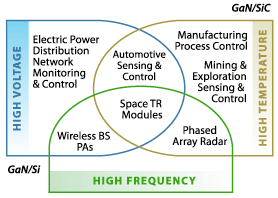

Integrated circuits and power devices utilized by the semiconductor industry for the production of advanced computers, consumer electronics, communication networks, and industrial and military systems have been almost exclusively based on silicon technology. The requirements of future electronics place a great emphasis on achieving new devices with greater power density and energy efficiency, especially in the power electronics arena. This emphasis poses an increasing challenge to come up with new design protocols, innovative packaging, and even new semiconductor materials, as it is widely believed that silicon technology has finally reached its fundamental physical limits. In addition to the devices’ electrical requirements such as voltage and power ratings, the operational environments of power systems might encompass challenging conditions that include radiation, extreme temperature exposure, and wide-range thermal cycling, where conventional silicon-based systems are incapable of survival or efficient operation.
Power semiconductor devices are critical to the development of lightweight, highly efficient electronic systems needed for a wide variety of applications such as planetary exploration, deep space missions, terrestrial power grids, industrial machinery, and geothermal energy extraction.
The next generation of power electronics necessitates different types of semiconductor materials as today’s dominant power semiconductor device material, silicon, is limited in terms of performance and efficiency at higher power levels and higher temperatures. WBG semiconductor devices, such as those based on GaN or silicon carbide (SiC), have emerged in the commercial market and have shown great potential to replace traditional silicon parts gradually in the high power arena.
The adoption of GaN has been advancing significantly over the last five years with several thousand devices been developed and implemented in applications such as radar, satellite communication, counter-IED jammers, 3G/4G base-stations, WIMAX/LTE PAs , CATV modules, and general-purpose applications.
Gallium Nitride has become strategic material. The technology has enabled military radars to operate at much higher frequencies and are used in jammers that allow fighter jets and other aircraft to fly undetected, said Colin Humphreys, a physics professor at Cambridge University. It is no surprise that United states want to stop China and Russia getting hold of gallium nitride technology, which can boost the power and sensitivity of weapons systems while reducing their cost as it requires less electricity.
U.S. earlier blocked a 670 million-euro ($713 million) Chinese bid for German chip equipment maker Aixtron (AIXGn.DE) over concerns of China gaining access to the secrets of producing Gallium nitride, a powdery yellow compound used in light-emitting diodes (LED), radar, antennas and lasers.