
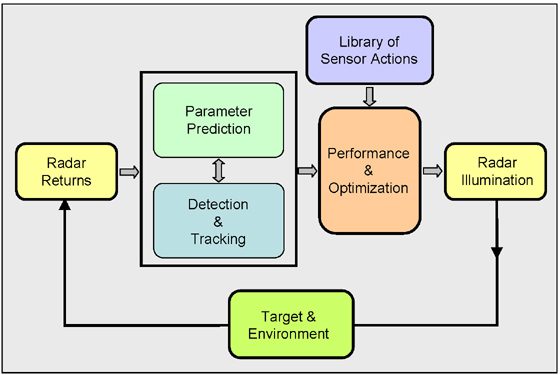

Today’s radars face an ever increasingly complex operational environment, intensified by the numerous types of mission/modes, number and type of targets, non-homogenous clutter and active interferers in the scene. The EM cluttered environment is a growing problem for ground- based and airborne radar systems.
This problem is becoming critical as the available frequency spectrum shrinks due to growing wireless communication device usage and spectrum management regulations. The commercial use of spectrum is scaling exponentially as cellular providers begin to roll out 5G, automotive manufacturers push V2X communication, and the Internet of Things drives wireless connectivity into a myriad of devices. Future systems require the ability to
anticipate the behavior of emitters in the operational environment and to adapt their transmissions in a cognitive fashion based upon the spectrum availability
“This problem is further exacerbated by the growing number of targets that the radar must detect. More capable radar systems are needed that can adapt to multiple targets while utilizing unoccupied frequency bands. Finally, radar, communication, and other electronic systems must be capable of operating without interfering with each other,” says ARL report by Anthony Martone and others.
Constantly changing environments represent an enormous challenge for modern driver assistance systems. To meet these challenges, software controlled automotive radars offer entirely new opportunities. They are compact, low cost, and also extremely versatile and highly reconfigurable.
Finally EW threats to radars have also become more complex and deadly due to electronic battlefield and development of advanced electronic warfare systems. Next-generation electronic warfare (EW) technology is being developed that will quickly detect, locate, and identify emitters of radio frequency signals over all threat bands and from all directions.
Thus, the ability to adapt ones transmit waveform, to optimally suit the needs for a particular radar tasking and environment, becomes mandatory. Cognitive and adaptive radars shall have capability to identify possible radio and sensor jamming threats and then transmit without affecting friendly signals. They shall be capable of sensing the environment and adapting transmissions and signal processing to maximize performance and mitigate interference effects in an increasingly cluttered EM environment. They shall also adapt to multiple targets of interest; and other radar, communication, and electronic systems that must operate without interfering with each other
The recent advances in hardware capability to generate arbitrary (phase and amplitude) design waveforms, high computation resources like FPGAs, Giga samples per second A/D and D/A convertors and machine learning algorithms are other drivers of cognitive and adaptive radars.