
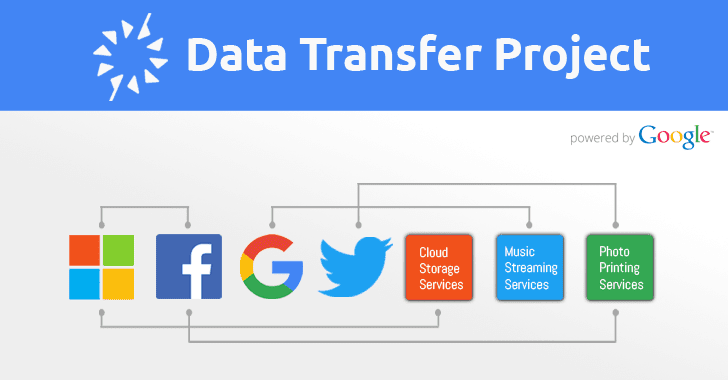

Moving your data between any two services can be complicated because every service is built differently and uses different types of data that may require unique privacy controls and settings, according to Facebook. For example, you might use an app where you share photos publicly, a social networking app where you share updates with friends, and a fitness app for tracking your workouts. People increasingly want to be able to move their data among different kinds of services like these, but they expect that the companies that help them do that will also protect their data. These are the kinds of issues the Data Transfer Project will tackle.”
The Data Transfer Project was formed in 2017 to create an open-source, service-to-service data portability platform so that all individuals across the web could easily move their data between online service providers whenever they want. Files like contacts, photos, mail, calendars, and tasks will be able to be transferred between platforms, without needing to download them and re-upload them to another site.
Google software engineer Brian Willard in a podcast said, “Mobile-only usage is growing, and Internet usage is growing in areas where connectivity is metered or connectivity isn’t that great,” he said. “In both of those cases, downloading data isn’t that tenable a solution.”
Willard also mentioned Europe’s General Data Protection Regulation (GDPR) as an incentive. GDPR, which was implemented in May 2018, requires stringent data protection and privacy controls for all European citizens, and one of its requirements is focused on data portability. More specifically, it requires that citizens be able to “receive personal data they have provided to a controller in a structured, commonly used and machine readable format” and request that a controller transmits this data directly to another controller.
The contributors to the Data Transfer Project believe portability and interoperability are central to innovation. According to the group’s mission statement, making it easier “to choose among services facilitates competition, empowers individuals to try new services, and enables them to choose the offering that best suits their needs.”
The Data Transfer Project uses services’ existing APIs and authorization mechanisms to access data. It then uses service specific adapters to transfer that data into a common format, and then back into the new service’s API. The code for the project is open-source, and is available for the public to view on GitHub.
Willard says, because each type of data—contacts, profile data, photos, and so on—has a different format. Further, the format for even one type of data, such as contacts, may be different depending on the service. To ensure smooth transfer, each company is responsible for building adapters to translate their APIs into a common format. Because the format is open, any company can build adapters to its APIs to gain access to information
While developing the project, Willard said, all participants are focusing heavily on data privacy and security. All data is encrypted both in transit and at rest with a unique key, and credentials are destroyed as soon as the transfer concludes. In addition, services must agree to allow data transfer among them, and will require that users authenticate each account independently. DTP also will monitor the number and frequency of transfers for each user and revoke tokens if they are leaked.
So far, the project has adapters for Google, Microsoft, Twitter, Instagram, Flickr, Remember the Milk and SmugMug, and can handle five data types: mail, contacts, calendar, photos and tasks. In the meantime, Google plans to work on building its adapters into the Google user interface.
For startups and smaller apps, the Data Transfer Project could end up having big implications. If users can seamlessly port data such as contacts, tasks, images and video, and even calendar updates from a larger service to a tinier one, it could give the latter a competitive boost. Users are more likely to use a new service if it’s quick and easy for them to seed their profile with all the preexisting data they need. If users can quickly and seamlessly port their personal data between applications, this project could radically change how apps are structured.