
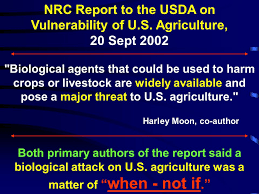

Food and agriculture are key elements of the critical infrastructure of every country because they provide products that are essential for life. The United States is a country with a highly developed agricultural sector. Food and agriculture constitute a sixth of the U.S. gross domestic product, totaling more than a trillion dollars per year, and exports of agricultural products make the largest positive contribution to the nation’s trade balance. Should biological warfare commence, food and agriculture will be targets because they are foundational to America’s health, welfare, and economy.
Yet, in this modern age of biological weapons, agriculture and agricultural products have been targeted by various nation states as viable strategic targets as well as targeted by terrorists (aka non-state actors) for acts of bioterrorism. The US Department of Agriculture in July 2020 warned residents against planting unsolicited packages of seeds arriving from China because they could harm the environment. At least eight states, from Washington to Ohio, have also told residents in recent days not to put the seeds in the ground, after they arrived apparently from China in the mailboxes of people who did not order them. Officials said the seeds could be invasive species that could threaten crops or livestock.
The USDA said it is “aware that people across the country have received unsolicited packages of seed from China in recent days.” The agency is working with the Department of Homeland Security and states to protect U.S. agriculture and prevent the unlawful entry of prohibited seeds, according to a statement.
There is long history of Biological Weapons Development or Attacks against Agricultural Targets. During World War II, the United States, Britain, and Canada were actively engaged in research and development of BW and eagerly exchanged technical information and research results. Japan, well known for the brutal use of BW against civilians and prisoners in China, was also actively researching and developing anti-crop and livestock BW. France anti-crop program was mostly directed at Germany. The former Soviet Union was known to have one of the most innovative and broad anti-crop and anti-livestock programs.
Number of analysts have pointed out that terrorist attacks on livestock or crops, although unlikely to cause terror, are also a concern because they could be executed much more easily and could have serious economic consequences. Parker describes five potential targets of agricultural bioterrorism: field crops; farm animals; food items in the processing or distribution chain; market-ready foods at the wholesale or retail level; and agricultural facilities that include processing plants, storage facilities, and components of the transportation sector as well as research laboratories.
Bioterrorists (aka non-state actors) might use agricultural BW in the following methods: multiple attacks with the pathogen at sites of high concentration of crops or livestock using contaminated animals (e.g. animals smuggled into the country with Avian influenza); pathogen aerosols (Karnal bunt teliospores for wheat crops or FMD in an aerosol for cattle); vectors carrying the pathogen (such as ticks with Heart water); or fruit bats or pigs (domesticated or feral) infected with Nipah virus.
Hickson describes the Fabian strategy (named after the Roman general Quintus Fabius Maximus, who defeated Hannibal by avoiding direct conflict) as a strategy of indirect actions used to weaken the resistance of an opposing force. This strategy could include BW directed at agricultural targets with the resultant effects of reduced export trade of agricultural commodities, food shortages, reduced employment for workers in agricultural and food related industries, reduced biofuels productivity (if the targets include biofuels crops), and due to the multiplier effects, overall decreased economic vigor of the nation. This could result in a subsequent cascade of socio-economic effects, including distrust and resistance to state or federal government authority; greater social dissent exemplified by public protests over food or fuel shortages and spiking food prices; riots over unemployment or food shortages. These final actions could indicate to an aggressor that the enemy is now weakened sufficiently so that a quick invasion and defeat is possible.
The threat is greater in developing nations that experience food and water insecurity on a higher scale than developed nations because of irresponsible or malicious government policies, the effects of climate change, and rising food prices. National security can be quickly jeopardized by naturally occurring threats to the crop system, including pathogens, drought, flooding, and frost, but especially by threats introduced by state or non-state actors.
India has so far not had any major bioweapons attack on its territory. However, the consequences to India if a threat emerges are higher because not only is Indian weather suitable for multiple organisms to grow, the paucity of good primary healthcare leaves populations at a high risk of epidemics. India is a large land mass, making effective implementation of anti-disease treatments cumbersome and difficult. Further India remains accessible through multiple fronts with air, sea, and land connectivity making it easy to transport biological agents. The instability of political connections in the neighbouring region and ongoing conflicts raise the threat of a potential bioweapons attack from across India’s borders, writes Shambhavi Naik in Takshashila Discussion Document.