
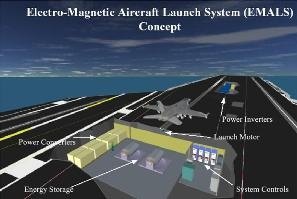

The Electromagnetic Aircraft Launch System (EMALS) is a type of aircraft launching system currently under development by General Atomics for the United States Navy. EMALS uses electrical energy to propel Aircraft by converting electric energy into kinetic energy. The system launches carrier-based aircraft by means of a catapult employing a linear induction motor rather than the conventional steam piston. EMALS was developed for the Navy’s Gerald R. Ford-class aircraft carriers and will be used in all future U.S. Navy aircraft carriers. US Navy has finished Load testing of the Electromagnetic Aircraft Launch System (EMALS) aboard the future aircraft carrier PCU Gerald R. Ford (CVN-78). The tests catapult “dead loads” placed on weighted sleds into the river.
Many countries are planning EMAIL systems for their future carriers. China will use one or more electromagnetic catapults for fighter jets on its third aircraft carrier, the Beijing-based Global Times has revealed, citing an anonymous expert within the military. Russia’s United Shipbuilding Corporation is reportedly external link developing a new aircraft launch system to be deployed on aircraft carriers. The company did yet not specify the characteristics of these systems or the timeframe of their development.
Converteam UK were working on an electro-magnetic catapult (EMCAT) system for the Queen Elizabeth-class aircraft carrier. In August 2009, speculation mounted that the UK may drop the STOVL F-35B for the CTOL F-35C model, which would have meant the carriers being built to operate conventional takeoff and landing aircraft utilizing the UK-designed non-steam EMCAT catapults. US has decided to release the crucial Electromagnetic Aircraft Launch System for the Indian Navy’s future aircraft carrier, according to the Trump administration.
Compared to steam catapults, EMALS weighs less, occupies less space, requires less maintenance and manpower, is more reliable, recharges more quickly, and uses less energy. This system allows for a more graded acceleration, inducing less stress on the aircraft’s airframe which could extend their lifetime and save maintenance costs. The EMALS will also be more efficient than the 5-percent efficiency of steam catapults.