
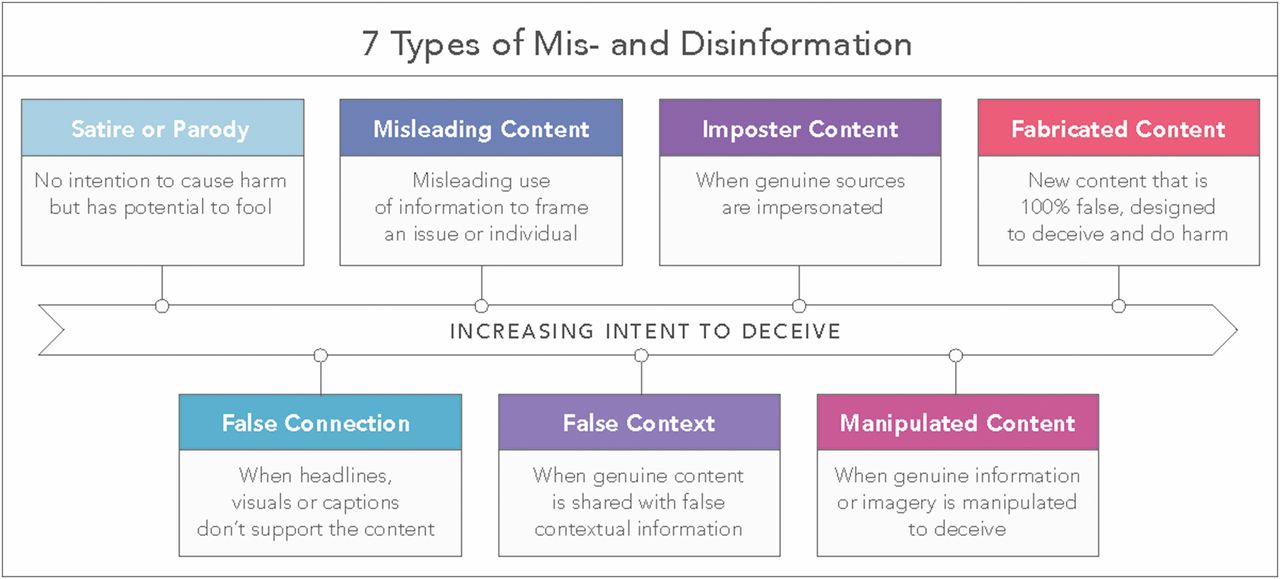

Fake news or junk news or pseudo-news is a type of yellow journalism or propaganda that consists of deliberate disinformation or hoaxes spread via traditional print and broadcast news media or online social media. This type of news, found in traditional news, social media or fake news websites, has no basis in fact, but is presented as being factually accurate.
Fake news is written and published usually with the intent to mislead in order to damage an agency, entity, or person, and/or gain financially or politically, often using sensationalist, dishonest, or outright fabricated headlines to increase readership. Similarly, clickbait stories and headlines earn advertising revenue from this activity.
The false information is often caused by reporters paying sources for stories, an unethical practice called checkbook journalism. Digital news has brought back and increased the usage of fake news, or yellow journalism. The news is then often reverberated as misinformation in social media but occasionally finds its way to the mainstream media as well.
The relevance of fake news has increased in post-truth politics. For media outlets, the ability to attract viewers to their websites is necessary to generate online advertising revenue. Publishing a story with false content that attracts users benefits advertisers and improves ratings. Easy access to online advertisement revenue, increased political polarization, and the popularity of social media, primarily the Facebook News Feed, have all been implicated in the spread of fake news, which competes with legitimate news stories.
Hostile government actors have also been implicated in generating and propagating fake news, particularly during elections. Fake news punctuated some of the most important elections of recent years, including 2016’s BREXIT referendum and U.S. presidential campaign.
Thanks to social media, fake news can now be disseminated at breakneck pace to vast audiences that are often unable or unwilling to separate fact from fiction. Studies suggest that fake news spreads up to six times faster on social media than genuine stories, while false news stories are 70 percent more likely to be shared on Twitter. Observers call it “spam on steroids.” If one spam email is sent to only 1,000 people, it effectively dies. However, if fake news is sent to the same number of recipients, it’s more likely to be shared, become viral, and eventually reach millions.
“Pizzagate and similar events show the unintended consequences of social media,” said NIU psychology professor Keith Millis, who studies comprehension and memory. Millis is a co-author on the analysis along with Dylan Blaum, an NIU graduate student in psychology, and Jean-François Rouet, director of research at the French National Center for Scientific Research at the University of Poitiers, France.
The analysis notes that the spread of false information can have dire consequences. The authors point to the example of the “pizzagate conspiracy” that cropped up online prior to the November 2016 election. It falsely claimed that Hillary Clinton was the head of a sex-trafficking ring that was using a pizza restaurant in Washington, D.C., to hold children captive. In December of that year, an assailant on a self-appointed mission to save the children entered the restaurant and fired an assault rifle before being arrested.
“…while the debate in the US is hyper-focused on the Facebook newsfeed, globally, the real challenge is closed messaging apps like WhatsApp, Viber, Telegram, and FB Messenger,” the study’s authors, who also conducted semi-structured interviews with a mix of 30 stakeholders such as internet service providers (ISPs), policymakers, media and influencers, fact-checkers, academia, and political parties, wrote. “Those who are relatively new to use of technology, internet and smartphones may be more susceptible to fake news than others.
“Importantly, our analysis shows that basic research in the social and behavioral sciences can help to explain why these events occur,” Millis says. “Knowing why something occurs is a huge step in changing behavior.”
The Indian government has been pressurizing the social network to implement steps to curb the spread of fake news. This gains even more significance ahead of the 2019 Lok Sabha elections in India. Just 2.7% of Indians believe the information they receive on social media platforms like Facebook, Twitter, and WhatsApp, according to a survey by the non-profit Internet and Mobile Association of India (IAMAI) and data journalism portal Factly. The real danger is misinformation disseminated by trusted news outlets or their friends and family, most of those surveyed said.