

The phonon is the physical particle representing mechanical vibration and is responsible for the transmission of everyday sound and heat. Understanding and controlling the phononic properties of materials provides opportunities to thermally insulate buildings, reduce environmental noise, transform waste heat into electricity and develop earthquake protection.
The concept of phonons was introduced in 1932 by Soviet physicist Igor Tamm. The name phonon comes from the Greek word φωνή (phonē), which translates to sound or voice because long-wavelength phonons give rise to sound. The name is based on the word photon. Shorter-wavelength higher-frequency phonons are responsible for the majority of the thermal capacity of solids.
The study of phonons is an important part of condensed matter physics. Phonon is a collective excitation in a periodic, elastic arrangement of atoms or molecules in condensed matter, like solids and some liquids. Phonons play a major role in many of the physical properties of condensed matter, like thermal conductivity and electrical conductivity.
Phonons may sometimes be thought of as particles, and sometimes as vibrational waves, analogous to the dual wave and particle nature of light. Physically, the phonons are manifested as a wave of density variation passing through a material, like the wave of compression that travels along a child’s Slinky toy when you stretch it out and give one end a shove.
Edwin L. Thomas, head of MIT’s Department of Materials Science and Engineering says phonons, which exist in all solids, are usually a nuisance that must be disposed of with cooling systems. They have been “denigrated and ignored, but they could be the future star attraction if we can train them to do tricks for us.”
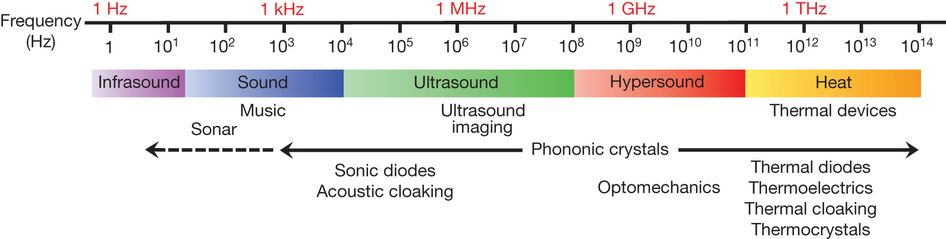
The development of new ideas for phonon management—combined with the ability to design and fabricate composite materials from the macroscale to the nanometre scale—has fuelled recent progress in sonic and thermal diodes, acoustic and thermal metamaterials, optomechanical crystals, hypersonic phononic crystals, thermoelectrics and thermocrystals. These advances have greatly increased our ability to manage the phononic spectrum at all relevant frequencies: sound, ultrasound, hypersound and heat.
The emerging field of phonon management has great potential for innovations in materials and devices that can precisely manipulate sound and heat. Our ability to control electrons and photons has driven major technological revolutions in past decades; perhaps from our new ability to control phonons precisely we may expect analogously surprising and exciting consequences.