
Electronics and sensors form the sensing, decision-making, and electromagnetic nervous system of modern military and technological power. From radars, electro-optical sensors, and electronic intelligence systems to jammers, electronic attack platforms, and advanced signal processing technologies, control of the electromagnetic spectrum is increasingly critical to achieving situational awareness, precision targeting, force protection, and information superiority. As warfare becomes more networked, autonomous, and data-driven, advances in sensing, electronic warfare, spectrum operations, and signal intelligence are reshaping the balance between detection and concealment, creating new opportunities and challenges across air, land, sea, space, and cyber domains.
IDST Intelligence Briefings
Radar systems, electronic attack and protection, spectrum dominance, sensor fusion, and counter-measure technologies.
Why This Magazine Exists
The electromagnetic spectrum is increasingly congested, contested, and strategically vital. This sub-magazine examines the technologies that enable forces to sense, detect, track, deceive, disrupt, and survive in complex operational environments, providing technical and strategic insights into the evolving worlds of sensors, electronic warfare, spectrum operations, and electromagnetic dominance.
What We Track
- Radar and sensing technologies
- Electronic attack, protection, and counter-measures
- Spectrum management and contested environments
- Sensor fusion and data integration
- EW integration with air, land, and naval systems
Latest Analysis & Intelligence
-

Ascending Horizons: The Evolution of Stratospheric Balloons and High-Altitude Surveillance
The Stratosphere Becomes a New Strategic Domain The boundary between air and space is becoming strategically important. At roughly 20–50 kilometres above Earth, the stratosphere sits above most conventional aircraft operations but below conventional satellite orbits. This unusual position gives high-altitude balloons and High-Altitude Platform Systems (HAPS) the potential to provide persistent surveillance, communications, electronic…
-

Coilguns: The Rise of Electromagnetic Weapons and the Future of Electrified Warfare
Strategic Context For more than a century, firearms have depended on essentially the same fundamental mechanism: chemical energy stored in a propellant is rapidly converted into pressure, accelerating a projectile through a barrel. The emergence of practical electromagnetic launch technologies raises a different question: what happens when the battlefield weapon becomes an electrical machine rather…
-

Exploring Graphene: The Future of Semiconductor Technology
Introduction: From Wonder Material to Post-Silicon Technology For more than half a century, the semiconductor industry has advanced by continuously shrinking and improving silicon transistors. That model is now encountering increasingly difficult physical, thermal and economic constraints. As artificial intelligence, high-performance computing, edge processing, 6G communications and autonomous systems demand dramatically greater computational throughput, the…
-

The RIS Revolution: How Reconfigurable Intelligent Surfaces Are Creating an Intelligent Electromagnetic Environment
Introduction: From Wireless Connectivity to Electromagnetic Intelligence The next phase of wireless competition will not be determined solely by faster radios, larger antenna arrays, or additional spectrum. It will increasingly depend on the ability to control the physical environment through which electromagnetic energy propagates. As 5G-Advanced networks move toward increasingly dense deployments and the industry…
-
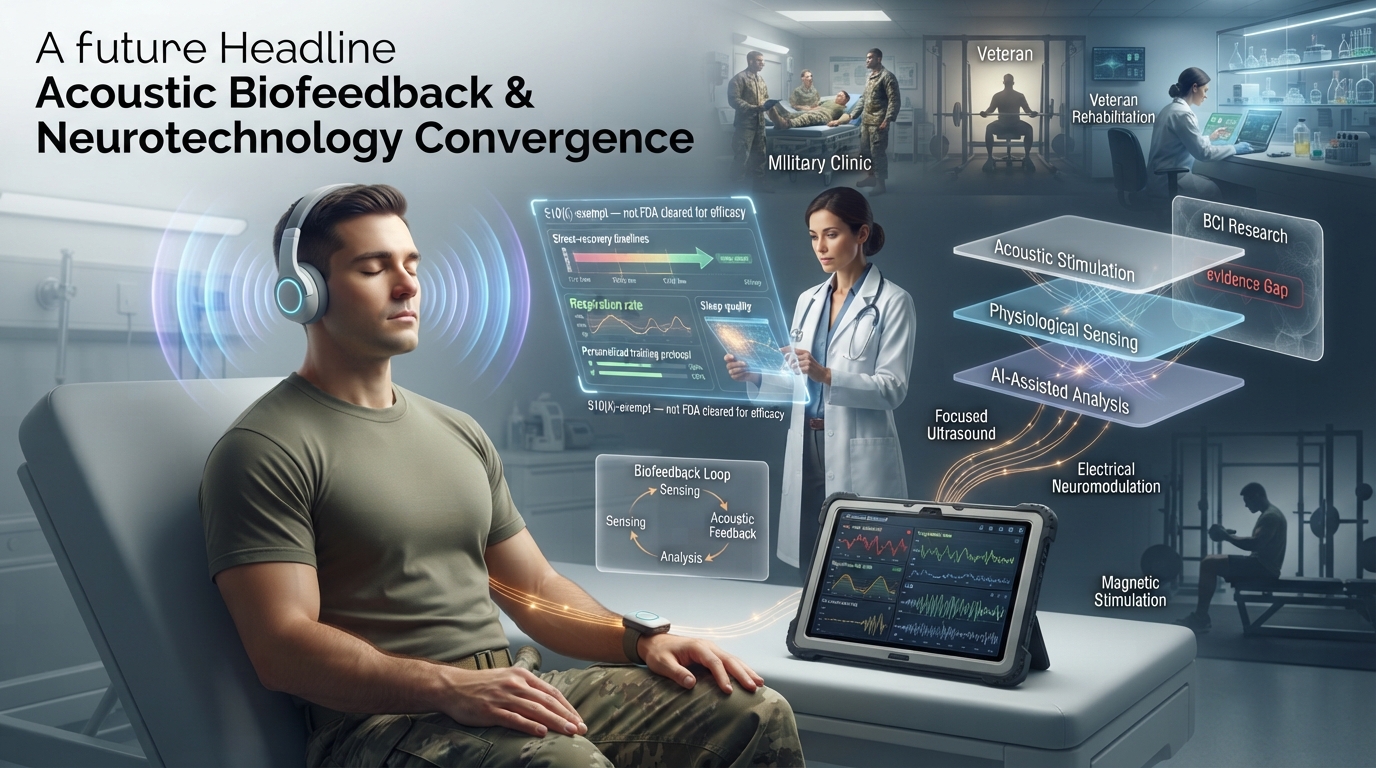
AI-Enabled Acoustic Neuromodulation and Biofeedback: NeuroVibe, Brain–Computer Interfaces and Emerging Military Medical Applications
Introduction: The Convergence of Acoustic Engineering, AI and Neurotechnology The convergence of acoustic engineering, physiological sensing, artificial intelligence (AI), and brain–computer interface (BCI) research is creating new approaches to non-invasive health monitoring and neurological intervention. These technologies seek to combine physical stimulation with the collection and interpretation of biological signals, allowing a system to observe…
-

Integrated Brillouin Photonics in 2026: Steering Light with Sound for GPS-Free Navigation, 6G Communications, and Quantum Systems
Introduction: Light, Sound, and the Next Strategic Revolution in Photonics As modern militaries and commercial industries prepare for an era defined by autonomous platforms, resilient communications, quantum technologies, and contested electromagnetic environments, photonic integrated circuits (PICs) are rapidly becoming foundational strategic infrastructure. Future navigation, sensing, electronic warfare, satellite communications, and 6G networks will require signal…
-

DARPA’s Microsystem Electricity Generation (MEG): Turning Waste Heat into Power for the Next Generation of Military AI and Semiconductor Systemsa
Introduction: Transforming Thermal Waste into Strategic Power The exponential growth of artificial intelligence, advanced semiconductor manufacturing, and autonomous defense systems is creating an unprecedented energy challenge. Every modern processor—from AI accelerators inside hyperscale data centers to mission computers aboard fighter aircraft, satellites, autonomous drones, and missile systems—converts nearly all of its electrical power into heat.…
Related Domains & Cross-Cutting Themes
Air and naval systems, cyber operations, AI-enabled sensing, communications resilience, and platform survivability.
Ethics, governance, and technology control
Industrial scaling and supply-chain constraints
Human–machine teaming and trust
Interoperability across platforms and institutions
Export controls and technological rivalry
Explore the Critical & Emerging Technologies Magazine →
Explore the Industry, Markets & Supply Chains Magazine →
Explore the Space Technology, Defense & Exploration Magazine →