
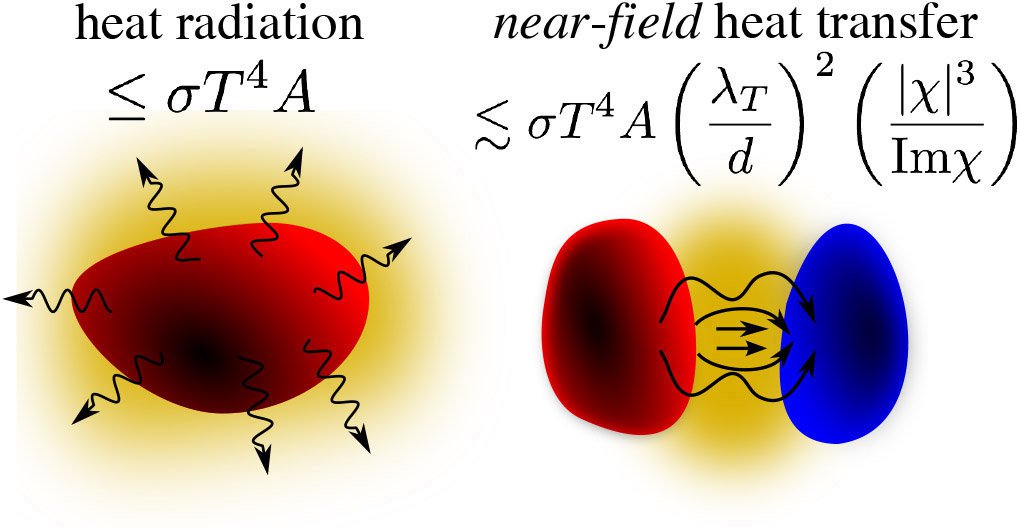

Heat (i.e., thermal energy) is defined as the energy that is transferred spontaneously between two bodies due to difference in their temperature; heat flows from high to low temperature. There are three main well-known mechanisms for heat transfer: conduction through solid and fluids, convection through fluid, and radiation through solid, fluid or even vacuum.
The fact that thermal radiation can flow in vacuum can be understood when we know that thermal radiation is basically electromagnetic radiation. Therefore, the exchange of heat between bodies takes the form of exchange in electromagnetic energy. According to the laws of physics, electromagnetic radiation can only be generated by accelerating charge; either electric or conceptually magnetic charges.
In the case of thermal radiation, the source of charge can be found is any kind of materials; since they are all comprised of electrons and nuclei with negative and positive charges, respectively. Even if the material is neutral on average, the charges can still emit radiation. These charges are accelerated while they vibrate randomly (in amplitude and direction) due to the internal energy they possess. These mechanical vibrations are the result of thermal fluctuations, customarily termed thermal motion.
This fluctuation is one of the essences of statistical mechanics; at a finite temperature above zero kelvin, the value of each microscopic property of the system fluctuates around its macroscopic average; and velocity of particles comprising the material is not an exception. Therefore, any matter at a temperature above zero kelvin is a source of electromagnetic radiation. Since the driving force for this radiation is the temperature of the matter, this kind of spontaneous electromagnetic radiation is called thermal electromagnetic radiation, or thermal radiation for short. The thermal fluctuation of charges is a mechanism to exchange energy (via thermal radiative heat transfer), and momentum as well (i.e., Casimir forces)
It is known from classical physics that the maximum possible intensity of thermal radiation can be emitted by a blackbody; a body that absorbs and emits electromagnetic radiation perfectly at all wavelengths and all angles. The blackbody radiation concept was cleverly theorized by Max Planck.
In radiant heat exchange, electromagnetic energy is radiated from a warm body to a cooler one. This kind of heat exchange can, for example, power a thermophotovoltaic cell. A ‘blackbody’—a structure that absorbs and emits optical rays with perfect efficiency—is the thermodynamic ideal of such a radiator.