
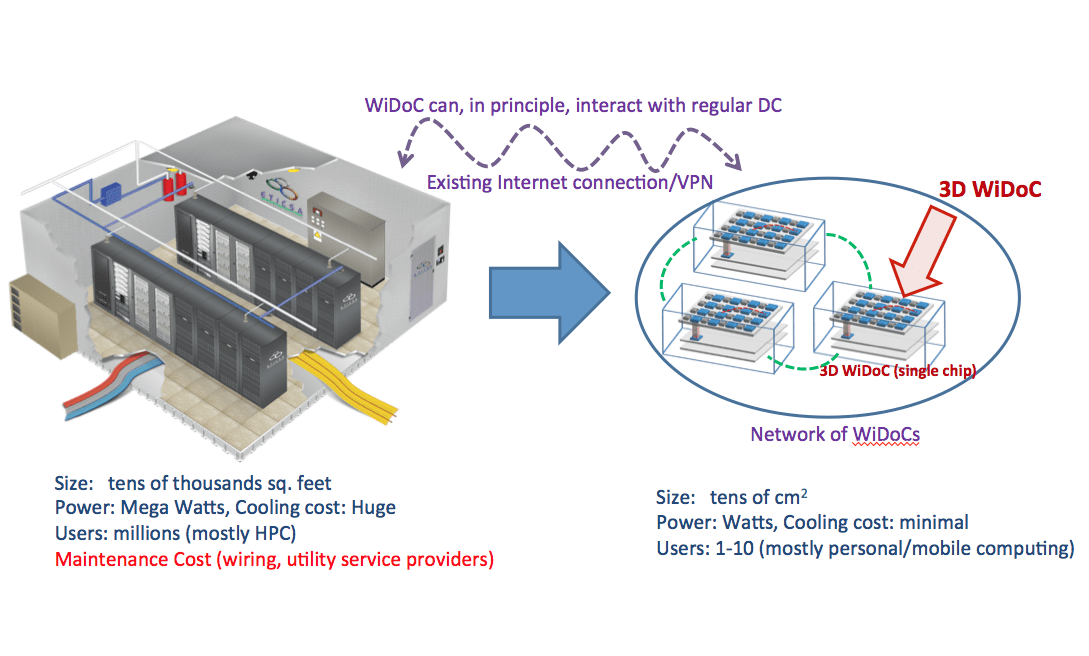

The technology industry is entering a new era of computing that requires IT systems and cloud computing services to process and analyze huge volumes of Big Data in real time. Current Data centers (DC) and high performance computing clusters are dominated by power, thermal, and area constraints.
Data centers consumed about 91 billion kilowatt-hours of electricity in the U.S. in 2013, which is equivalent to the output of 34 large, coal-fired power plants, according to the National Resources Defense Council. They occupy large spaces and necessitate sophisticated cooling mechanisms to sustain the required performance levels. Sustainable computing has become of increasing interest to researchers, industry leaders and the public.
Datacenter-on-chip technology puts the equivalent of a huge data center, which uses enormous amounts of energy in large facilities to crunch data for companies like Google or Amazon, on a single computer chip. The chip includes thousands of processors, or cores.
Diana Marculescu and Radu Marculescu have been awarded an NSF grant to develop a new Datacenter-on-a-Chip (DoC) design consisting of thousands of cores that can run compute- and data-intensive applications more efficiently compared to existing platforms. Our research will impact numerous areas,” says Diana Marculescu. “Big data applications like social computing, life sciences, networking, and entertainment will benefit immensely from this new design paradigm that aims at achieving server-scale performance from hand-held devices.”
The U.S. Army is interested in such many core platforms for large real-time battle simulations and for battle information management software. Many military applications such as electronics for war fighters and unmanned aerial vehicles also require both high performance computing and low power consumption.
US Army Research Office has provided grant to Washington State University and Carnegie Mellon University team to develop a novel computing platform for emerging big data applications. The researchers, including Partha Pande and Jana Doppa, professors in the School of Electrical Engineering and Computer Science, and professors Radu Marculescu and Diana Marculescu from Carnegie Mellon, that are designing datacenter-on-chip (DoC) technology for faster and more energy-efficient data processing and better performance for big data applications.
US Army expects Big Data analytics to play a key role in maintaining information dominance, according to the Army Research Laboratory’s Technical Implementation Plan for 2015-2019. Termed “Very Large Scale Computational Analytics” in the plan, the initiative “will aid in the U. S. Army’s information supremacy by pursuing concepts that enable analysis of big data in realistic timeframes, limit tactical surprise, improve situational awareness, and facilitate intelligence for autonomy,” the plan reads.