
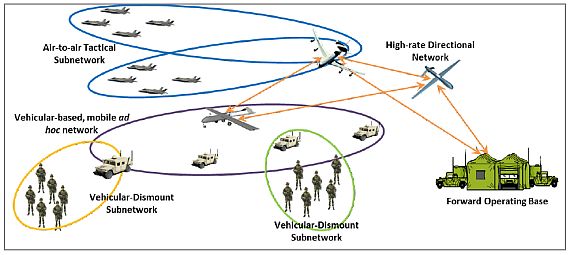

When in the field, military service members rely on their mobile devices to provide access to wireless networks in areas lacking a communications infrastructure. The protocols used for these networks determine the best config urations, and therefore trust all information shared about the security and operational state of each node. This poses a huge problem for service members.
In areas lacking trustworthy communications infrastructure, deployed service members rely on wireless devices to perform double duty: they not only provide access to the network; they are the network. In particular, the protocols that have been developed for military wireless networks require the nodes in the network to coordinate among themselves to manage their resources (e.g., spectrum, time, and power) and also to organize themselves in order to provide the functionality necessary to deliver data efficiently.
As the use of wireless systems expands, the likelihood of network compromise (whether maliciously or by unwitting misconfiguration) will increase. Beyond the conventional node-by-node security in use today, a set of network-based checks are needed to ensure that misinformation inserted into the control protocols does not disable the network functionality.
“Current security efforts focus on individual radios or nodes, rather than the network, so a single misconfigured or compromised radio could debilitate an entire network,” said Wayne Phoel, DARPA program manager. Acknowledging that the network can be compromised, the Wireless Network Defense program will develop and demonstrate new technology for robustly controlling wireless networks. This program will not create a new communications waveform nor develop a new tactical radio. Instead, the technology will be developed in such a way as to enable improvement in the robustness of the class of wireless networks that are being procured and fielded in the near future, and also to provide a reliable foundation on which to build the subsequent generation of wireless systems.
To help address these issues, DARPA has created the Wireless Network Defense program. The program aims to develop new protocols that enable military wireless networks to remain operational despite inadvertent misconfigurations or malicious compromise of individual nodes.
“We need to change how we control wireless networks by developing a network-based solution for current and future systems that acknowledges there will be bad nodes and enables the network to operate around them,” said Dr. Phoel. Private-sector technologies and social networking could be the answer to DARPA’s challenges. Phoel gave examples of credit card companies using indicators such as unusual purchase locations to determine whether a credit card has been stolen. He also noted that social sites that buy and sell personal items use ratings to help users decide if a seller is trustworth