
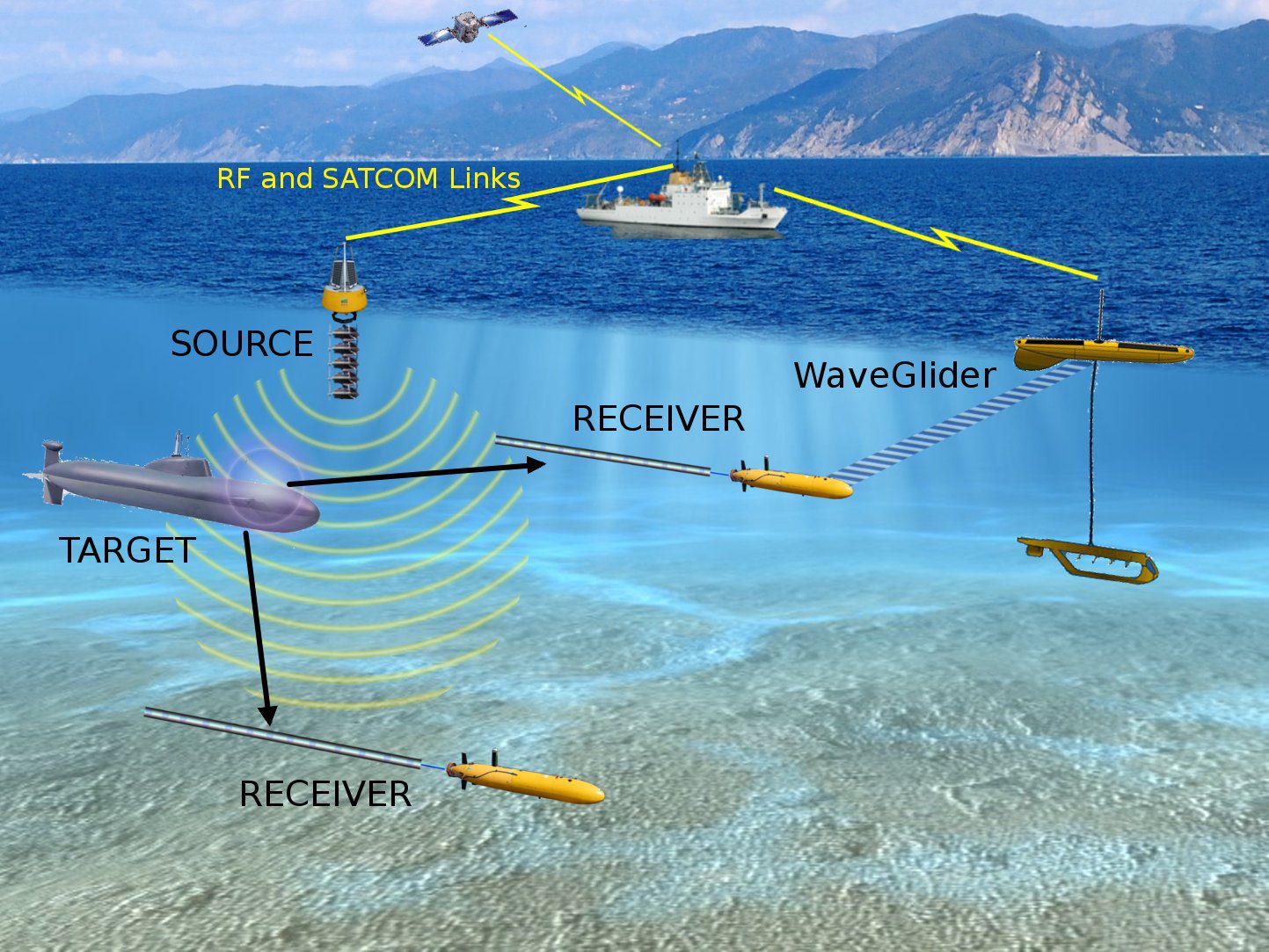

Sonars are one of the primary systems for detection and tracking of submarines in Anti Submarine warfare. However modern nuclear and diesel electric submarines have become very stealthy and quiet. Another challenge is diesel-electric submarines operating in littoral waters which generate high false alarm rates (FAR). One of the ways of overcoming such challenges and detecting stealthy and quiet submarines is Multi static sonar. These systems rely on Network of Active and Passive sonars collaboratively tracking the stealthy targets.
Earlier sonars were of Scanning sonar type which generally had a single transducer that is used for both transmit and receive. When these sonars ping, they generate a single beam (i.e. sound focused in a single direction). When receiving the echoes, these systems are able to produce a single “line” of returns along the direction the beam is pointing. After each cycle, the sonar points to a different direction and repeats the process. They do not offer a complete picture until all the angles have been processed. Eventually, after many pings, the system can scan the entire volume of interest and produce a complete image of the coverage zone.
Phased-array Sonars are designed to electronically change the direction of radio waves without requiring physical antenna movement. Phased array antennas are used for a variety of underwater applications, enabling multiple source emitters to preferentially direct energy toward a desired spatial direction. The beamforming algorithm aligns (phases) signals from individual radiators so that energy from the multiple radiating apertures coherently combines at the desired location with an increased signal level due to the array gain. This reduces power requirements for individual sources and minimizes the amount of energy produced in other directions.
Within the underwater acoustic domain, phased arrays have traditionally consisted of a fixed set of physically connected transmitters, requiring cumbersome cabling, challenging deployment, and the inability to reconfigure the array aperture.
One big advantage of array processing is that the entire volume of interest can be covered with a single transmit/receive cycle. In FarSounder’s FS-3DT product, the software produces approximately 2,400 beams pointing to 2,400 separate angles (~61 horizontal angles by 41 vertical angles) with a single ping. By looking in both vertical and horizontal directions, the software can generate a 3-dimensional image.
In contrast Standard scanning sonars to produce an equivalent 3-dimensional image would require ~2,400 pings. This would be too slow from both the navigation point of view, and underwater Threat Detection requirement.
An alternate approach is to form a distributed source network that is capable of cohering the output from each source to a desired location. This has been explored in other domains such as radar surveillance, radio frequency (RF) communications, and sound localization. A similar
concept for underwater acoustics would provide significant advantages relative to current array capabilities.
DARPA launched Tactical Exploitation of the Acoustic Channel (TEAC) program in 2017 to build phased-array sonar technology compatible with unmanned naval vessels. DARPA officials say they are interested in developing a system with a modest number of independent distributed acoustic transmitters that can increase the signal-to-noise ratio (SNR) and focus the acoustic energy from the transmitters at the receiver. The program seeks to harness advances in undersea vehicles and acoustic source technologies to enable long-duration sonar transmitter payloads on relatively small and affordable platforms.
The ability to cohere several moving sources underwater is very challenging, DARPA officials point out. It requires the ability to estimate the positions of sonar transmitters relative to each other to introduce the appropriate time delay or complex phase.
Such technology also might require channel and motion mitigation, depending on the diversity of the underwater propagation and the motion of sonar transmitters. Experts from STR and APS may use inter-source communications for localization and coordination, but will have to address potential communication delays, DARPA researchers say.