

In March 2016, DARPA officials launched the Spectrum Collaboration Challenge (SC2), an initiative designed to ensure that the exponentially growing number of military and civilian wireless devices will have full access to the increasingly crowded electromagnetic spectrum particularly between 9 kHz and 275 GHz, the range allocated by the Federal Communications Commission (FCC). These networks will be capable of intelligently optimizing the spectrum by collaborating with, and learning from, the other systems that occupy the spectrum with them.
The challenge is expected to both take advantage of recent significant progress in the fields of artificial intelligence and machine learning and also spur new developments in those research domains, with potential applications in other fields where collaborative decision-making is critical.
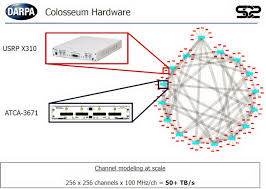
DARPA’s Colosseum is a path-breaking testbed that can emulate tens of thousands of possible interactions among hundreds of wireless communication devices—including cell phones, military radios, Internet-of-Things devices, and a litany of others—operating simultaneously in a square-kilometer expanse.
Traditional wireless communications systems are defined by a specification—a document that is the product of years of study and debate, and prescribes precisely how a radio system will work and how, if at all, it will get along with other radios. “We are asking SC2 competitors to devise fundamentally new radio systems that can learn from each other in real-time, making the need for arduous radio specifications obsolete,” Tilghman said.
“By contrast, SC2 is asking a group of radios that weren’t designed to work together to learn how to optimize spectrum capacity in real-time, and is relying on artificial intelligence to find and take advantage of ‘gaps’ and other opportunities to increase efficiency. You can’t satisfactorily learn how to solve this puzzle unless you address it at scale, and that’s why the Colosseum is such a critical part of the solution.”
That’s a significant technical challenge in itself, but it carries with it the challenging need to develop a testbed that can put those radios through a set of realistic paces.“Traditional radio systems are designed to ensure they operate only in pre-programmed ways, so it’s perfectly acceptable to test them in relatively small numbers and in simple environments,” Tilghman said.
DARPA’s Colosseum, a next-generation electronic emulator of the invisible electromagnetic world has been opened to competitors vying for $3.75 million in prize money for the Agency’s three-year Spectrum Collaboration Challenge (SC2).
“The Colosseum is the wireless research environment that we hope will catalyze the advent of autonomous, intelligent, and—most importantly, collaborative—radio technology, which will be essential as the population of devices linking wirelessly to each other and to the internet continues to grow exponentially,” said SC2 program manager Paul Tilghman.