
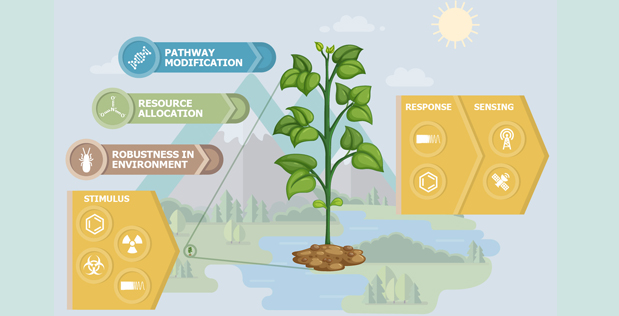

DARPA has launched a new surveillance program which plans to use genetically engineered plant as battlefield surveillance sensors. DARPA’s new Advanced Plant Technologies (APT) program looks to seemingly simple plants as the next generation of intelligence gatherers. Traditional sensors are not always optimal for obtaining timely, accurate information as national security landscape has grown far more complex and the challenges of monitoring distributed activity far more complicated, says DARPA.
DARPA’s vision for APT is to harness plants’ natural mechanisms for sensing and responding to environmental stimuli and extend them to detect the presence of certain chemicals, pathogens, radiation, and even electromagnetic signals. APT aims to modify the genomes of plants in order to program in these specific types of sensing and trigger discreet response mechanisms in the presence of relevant stimuli, and do so in a way that does not compromise the plants’ ability to thrive.
The program will pursue technologies to engineer robust, plant-based sensors that are self-sustaining in their environment and can be remotely monitored using existing hardware. The technology have already been experimented by many researchers. Engineers from MIT have already demonstrated turning spinach plants into sensors that can soak up explosive molecules from groundwater, detect their presence and then transmit that information to a handheld device. The plants were designed to detect nitroaromatics, which are often used in landmines and other explosives. When one of these chemicals is present in the groundwater sampled naturally by the plant, carbon nanotubes embedded in the plant leaves emit a fluorescent signal that can be read with an infrared camera.
The development from a team at MIT is said to be one of the first demonstrations of engineering electronic systems into plants, an approach dubbed plant nanobionics. “The goal of plant nanobionics is to introduce nanoparticles into the plant to give it non-native functions,” said Michael Strano, the Carbon P. Dubbs Professor of Chemical Engineering at MIT and the leader of the research team.
If the program is successful, it will deliver a new sensing platform that is energy independent, robust, stealthy, and easily distributed. Such sensors could find application outside of the military too, making it possible, for instance, for communities to safely identify landmines or unexploded ordinance leftover from past conflicts or testing grounds. To meet this demand, the Department of Defense invests heavily in the development of powerful electronic and mechanical sensors, and in the manpower to maintain and operate those sensors.