

Precision Guided Munitions (PGMs), and other so-called “smart” weapons, have established themselves as a key military technology against targets whose destruction requires a high degree of precision.
PGMs may include Bomb or missile that can be aimed and directed against a single/multi targets, relying on external guidance or its own guidance system. They can be launched from aircraft, ships, submarines, and land vehicles, or even by individual soldiers on the ground. They have high probability of hitting a target depending on timely and accurate intelligence.
PGMs provide enhanced lethality and efficiency to military against point targets by their ability to destroy any selected target at will with minimum collateral damage to both attacker and defender. Their stand-off engagement capability has given rise to the concept of “empty battlefield.” They have enhanced military effectiveness from “multiple-sorties-per-target” to “multiple-targets-per-sortie.”
Precision strikes depend on accurate navigation throughout the entire course of a missile’s flight. GPS is a key enabling technology for existing and future military precision navigation applications. Modern high performance PGMs typically employs multiple technologies to improve their robustness and accuracy. GPS provide autonomous, all Weather capabilities however is vulnerable to countermeasures.
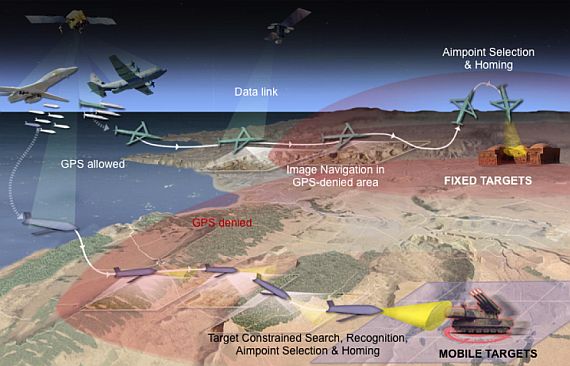
DARPA launched SECTR program seeking to design and demonstrate a low size, weight, power, and cost (SWaP-C) seeker prototype capable of providing day/night navigation and precision terminal homing to a weapon platform which may engage moving, relocatable and stationary targets in a contested environment where GPS may not be reliably available.
The SECTR seeker will be for use in a heavily contested environment, where laser target designation is unavailable and where continuous intelligence, surveillance, and reconnaissance (ISR) support to the kill chain may not be available, DARPA officials explain.
The DARPA SECTR program is important because critical gaps exist in U.S. military capability to target and destroy moving, relocatable, and stationary targets under GPS-jammed conditions using low-SWaP-C seekers that can operate during day and night conditions, DARPA officials say. Moving and relocatable targets in particular pose continual strategic and tactical threats to the U.S. military and the U.S. homeland.