
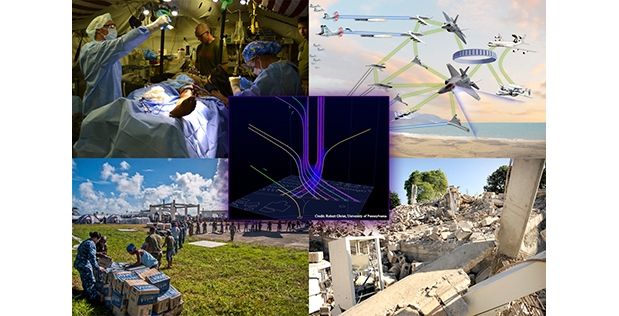

DARPA in recent years has focused heavily on the need to disaggregate complex military systems and to evolve a portfolio of “system-of-systems” architectures to better manage national security applications and improve the survivability and mission success of military platforms. A core remaining challenge, however, has been the lack of sophisticated tools to model and systematically design complex systems of systems. DARPA’s Complex Adaptive System Composition And Design Environment (CASCADE) program is addressing this shortcoming by developing novel mathematical foundations that can provide a unified view of system behavior and, ultimately, a formal language and tool kit for complex adaptive-system composition and design.
Complex interconnected systems are increasingly becoming part of everyday life in both military and civilian environments. Complex adaptive systems are those systems which have the additional important property of being adaptive—i.e., the structure and behavior of the system changes over time in a way which tends to increase its success.
In civilian settings such as urban “smart cities”, critical infrastructure systems—water, power, transportation, communications and cyber—are similarly integrated within complex networks. Exponential growth of Internet and integration of Cyber into military operations and rise of cyber warfare has also turned cyber domain as the complex adaptive system.
Military also has to deal with complex adaptive systems. The Army’s new operating concept includes dispersed operations for anti-access environments. The Marine Corps is experimenting with distributed operations across the littorals. The Naval Postgraduate School is researching aerial swarm combat. DARPA’s System of Systems Integration Technology and Experimentation program aims to disaggregate aircraft capabilities into a swarm of cooperative, low cost expendable air vehicles to operate in this A2/AD environment.
Adaptive search and rescue capability for downed airmen or forward operators in hostile environments, with options including novel autonomous and/or manned land, sea or air assets with coordination using land, sea, air, space and cyber systems. Dynamic systems such as these promise capabilities that are greater than the mere sum of their parts, as well as enhanced resilience when challenged by adversaries or natural disasters.
To overcome this challenge, DARPA has announced the Complex Adaptive System Composition and Design Environment (CASCADE) program. CASCADE aims to fundamentally change how we design systems for real-time resilient response within dynamic, unexpected environments,” said John Paschkewitz, DARPA program manager.
The goal of CASCADE is to provide both a unified view of system behavior, allowing understanding and exploitation of these complex interactions, and a formal language for complex adaptive system composition and design. This unified view of system behavior, enabled by appropriate mathematical foundations, will also enable adaptation to unanticipated environments using arbitrary system components by providing a framework to dynamically identify and correct deficient system capabilities.
Under another program, The Defense Advanced Research Projects Agency has developed mathematical tools and methods to help designers understand risks associated with the design and modeling of large military systems such as aerospace vehicles and engines.Researchers in DARPA’s Enabling Quantification of Uncertainty in Physical Systems (EQUiPS) program are developing theoretical foundations to simplify design processes for unconventional defense systems, where the number of parameters, or system features, can be in the thousands. Teams have developed uncertainty quantification tools to increase chances that new military systems will perform as designed, DARPA said.