

Blockchain is a transformative technology for the two billion people in the world currently underserved by financial institutions. The technology has the potential to enhance privacy, security and freedom of conveyance of data. Blockchain is based on open, global infrastructure, decentralized public ledger of transactions that no one person or company owns or controls, ensures security of transfer of funds through public and private cryptology and third parties to verify that they shook, digitally, on an agreement.
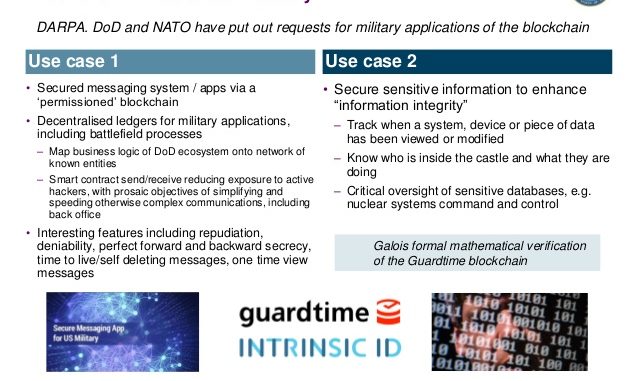
The same technology used for virtual currencies is now being researched by the Department of Defense to create tamper-proof military computer systems, including those systems used to control America’s nuclear weapons. The Department of Defense also looking to blockchain for development of a secure messaging system that would use the standard encryption and security features of current messaging apps such as WhatsApp, Signal, or Ricochet, but also use a decentralized Blockchain-like backbone structure that would be more resilient to surveillance and cyberattacks.
“Technologies for distributed consensus protocols have been revolutionized by their prominent role in cryptocurrency and blockchain technologies. These technologies have dramatic implications for the security and resilience of critical data storage and computation tasks, including for the Department of Defense,” says DARPA.
For military, blockchain technology could create important intelligence around whether a hacker has modified something in a database, or if they are intruding and surveilling a particular military system. As Timothy Booher, who leads the DARPA blockchain efforts, describes the use of blockchains with the analogy of defending a castle. You can build walls higher and higher (i.e. network security measures), but people might still be able to find a way in no matter how well you think you sealed up all the cracks. It’s actually more important to know who has been inside the castle and what they did while inside the walls. A blockchain could log that sort of information, making it considerably harder to steal or modify files in a system.
However, the only way to keep that progress moving along is to continually bring in new developers. To learn more about this technology, a two-day blockchain workshop is scheduled to be hosted by the U.S. Defense Advanced Research Projects Agency (DARPA) in February 2019.
In May 2017, DARPA awarded a grant to messaging app Crypto-Chat developer ITAMCO to develop an encrypted, blockchain-based messaging and transaction platform for the U.S. military.