
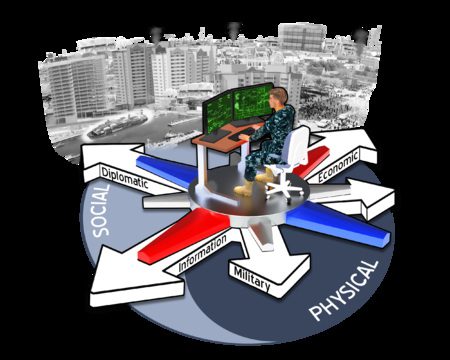

Hybrid Warfare (HW) is a military strategy that blends conventional warfare, irregular warfare, cyber warfare and subversion, and blurs the formal distinction between war and peace. It is often characterised by the use of fictitious propaganda, deniable forces, espionage, the mobilisation of ethnic, linguistic or confessional minorities, and terrorism.
An emergent type of conflict in recent years has been coined “gray zone,” because it sits in a nebulous area between peace and conventional warfare, says DARPA. Gray zone conflicts are those in which state and non-state competition becomes conflict but remains below the level of conventional warfare. Experts have pointed to Russia’s use of hybrid threats in Ukraine and other areas, along with China’s aggression in the South China Sea as examples.
Daesh makes the most extensive use of the internet and social media for radicalisation, recruitment and propaganda. Iran, which has a well developed cyber capability, has mounted destructive attacks causing physical damage in the real world. To date Daesh, AQ and the Taleban have mounted Distributed Denial Of Service (DDOS) attacks to take down temporarily websites they oppose. Daesh, AQ and the Taleban have used extreme violence as political messaging. They also have plans to use Biological or Chemical weapons..
Gray-zone action is not openly declared or defined, it’s slower, and is prosecuted more subtly—using social, psychological, religious, information, cyber and other means to achieve physical or cognitive objectives with or without violence. The lack of clarity of intent—the grayness—makes it challenging to detect, characterize, and counter an enemy fighting this way.
To better understand and respond to an adversary’s gray-zone engagement, DARPA’s Strategic Technology Office announced a new program called COMPASS, which stands for Collection and Monitoring via Planning for Active Situational Scenarios. The program aims to develop software that would help clarify enemy intent by gauging an adversary’s responses to various stimuli. COMPASS will leverage advanced artificial intelligence technologies, game theory, and modeling and estimation to both identify stimuli that yield the most information about an adversary’s intentions, and provide decision makers high-fidelity intelligence on how to respond–-with positive and negative tradeoffs for each course of action.
Current military decision-making follows a well-understood and effective OODA loop—Observe, Orient, Decide and Act. This is how planning is done in various geographic areas around the world, which works for traditional kinetic scenarios, Barlos said. This process, however, is not effective in gray zone warfare. Signals in the environment are typically not rich enough to draw any conclusions, and, just as often, adversaries could implant these signals to induce ambiguity. COMPASS aims to add a dynamic, adaptive element to the OODA loop for complex, gray-zone environments.
“The ultimate goal of the program is to provide theater-level operations and planning staffs with robust analytics and decision-support tools that reduce ambiguity of adversarial actors and their objectives,” said Fotis Barlos, DARPA program manager. “As we see increasingly more sophistication in gray-zone activity around the world, we need to leverage advanced AI and other technologies to help commanders make more effective decisions to thwart an enemy’s complex, multi-layered disruptive activity.”