
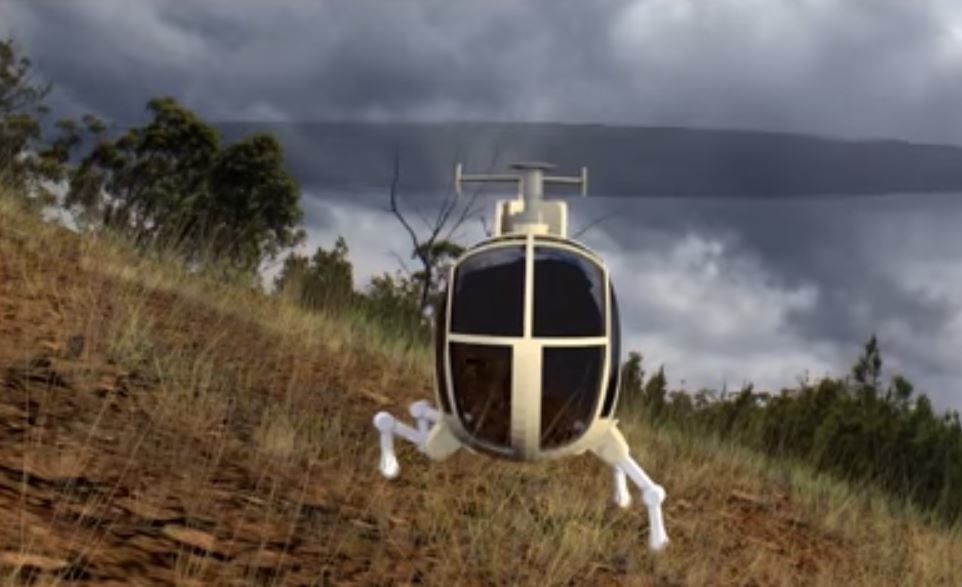

Despite their airborne maneuverability, helicopters, with their skid-or-wheel landing gear, still need a level surface to set down which are scarce in combat and rescue missions. Landing on an uneven surface could them to tip over or the rotor blades to come into contract with the ground resulting in disaster. And there are plenty of uneven surfaces on battlefields, ships and disaster areas.
Researchers with the Defense Advanced Research Projects Agency and the Georgia Institute of Technology are developing a system that would give helicopters the ability to handle rugged terrain or moving surfaces (such as ship being tossed in roiling waters). DARPA recently demonstrated a new robotic landing gear system in an unmanned flight near Atlanta, Georgia, “The equipment—mounted on an otherwise unmodified, unmanned helicopter—successfully demonstrated the ability to land and take off from terrain that would be impossible to operate from with standard landing gear,” said Ashish Bagai, DARPA program manager. The adaptive system consists of a four-legged undercarriage that replaces the standard landing gear. The effect is four independently articulated legs that fold up against the fuselage of the ship after takeoff and extend on landing.