
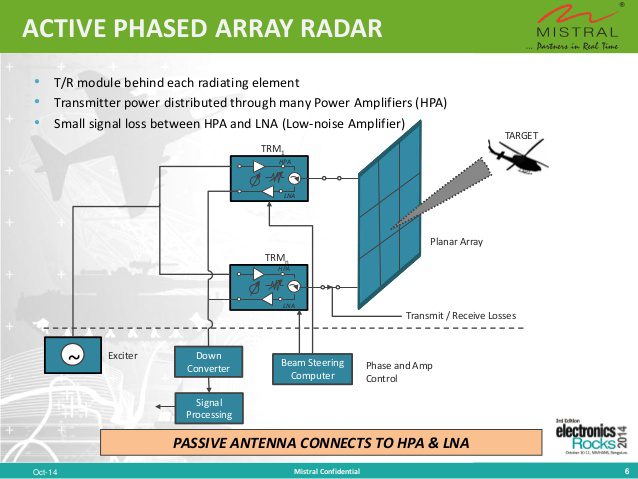

Next-generation radar systems are critical to providing situational awareness of the entire networked battlefield. Active Electronically Steered Array (AESA) antennas have revolutionized the performance of modern radars, communication and electronic warfare systems by greatly reducing the maintenance costs and failure rates, enhancing scanning speed and accuracy, more resistant to interference and providing multifunction capability.
Active electronically scanned array (AESA) radar systems operating in bands from UHF to X-band can produce very high-pulsed powers for surveillance applications or multiple simultaneous beams for shorter distance targeting and acquisition applications.
They contain a number of solid-state transmit/receive (T/R) modules that are combined at the antenna input. This array architecture enables simultaneous functions ranging from radar surveillance and fire control to jamming and advanced data link communications. Multifunction AESA versatility also enables dramatic improvements in target tracking, they allow for high-precision, multi-target tracking spanning both short- and long-range threats. The maturity, production ability and low risk of the GaN-based Radar Modular Assemblies are underpinning development of next generation radar system.
The EM systems like Transmit and receive (T/R) modules are assembled with monolithic microwave integrated circuits (MMICs) and large discrete (off-chip) magnetic components such as circulators, isolators, and inductors. These components use magnetic materials that exploit unique physics and functionality not available in electronic components. For example Circulators in T/R modules use magnetic materials to efficiently control the flow of electrical signals between the antenna terminal, transmit power amplifier, and receiver low noise amplifier.
However, current magnetic components such as circulators, inductors, and isolators, are bulky and cannot be integrated with miniaturized electronic circuitry. High packing densities achievable on MMICs, the result of decades of investment in scalability and integration of elements such as transistors, resistors, and capacitors on semiconductor chips, are not achievable with current magnetic components. As such, critical magnetic components must be assembled off-chip, which adversely affects cost, size, weight, and power (C-SWaP) and constrains RF system design.
DARPA launched Magnetic Miniaturized and Monolithically Integrated Components (M3IC) program in 2016 with a goal to achieve circulators, isolators, and gyrators that can be integrated into standard semiconductor processes and replace discrete devices. This will reduce the size, weight, and power (SWaP) of magnetic components, enhance their functionality and offer new mechanisms for the control and manipulation of electromagnetic (EM) systems for communications, radar, and electronic warfare (EW).
For instance, tighter integration of electronic and magnetic components could yield smaller radar systems, higher bandwidth communication over longer ranges, improved jam resistance, and more resilient EW systems. The miniaturization and lighter-weight system design of T/R modules shall allow AESA systems to be placed onto smaller operational platforms – such as unmanned aerial vehicles (UAVs) – that would otherwise be unable to provide critical sensor data in the battlefield.
DARPA’s announced funding for Metamagnetics for Magnetic, Miniaturized, and Monolithically Integrated Component (M3IC) program. Mike Hunnewell, director of business development, said in a statement, ” the research will focus on integrating miniaturized magnetic components into the microelectronics mix, with the goal to catalyze chip-based innovations in radar and other radio frequency (RF) systems. The program will span over the next five years and will hopefully open a pathway to more capable electromagnetic systems.”