

Machine learning (ML) methods have demonstrated outstanding recent progress and, as a result, artificial intelligence (AI) systems can now be found in myriad applications, including autonomous vehicles, industrial applications, search engines, computer gaming, health record automation, and big data analysis.
However, Current ML systems experiencing errors when they encounter circumstances outside their programming and/or training must be taken off-line and re-programmed/retrained. Taking a system offline and re-training it is expensive and time-consuming, not to mention that encountering a programming/training oversight during execution time can be disruptive to a mission.
Current ML systems are also plagued with another significant problem known as catastrophic forgetting. These systems ‘forget’ previously incorporated data when trained with new data and unless programmed or trained for every eventuality, these systems operating in real-world environments are bound to fail at some point. This means ML is restricted to specific situations with narrowly predefined rule sets.
At the same time, current ML systems are not intelligent in the biological sense. They have no ability to adapt their methods beyond what they were prepared for in advance and are completely incapable of recognizing or reacting to any element, situation or circumstance they have not been specifically programmed or trained for.
This issue presents severe limitations in system capability, creates potential safety issues, and is clearly limiting in Department of Defense (DoD) applications, e.g., supply chain, logistics, and visual recognition, where complete details are often unknown in advance and the ability to react quickly and adapt to dynamic circumstances is of primary importance.
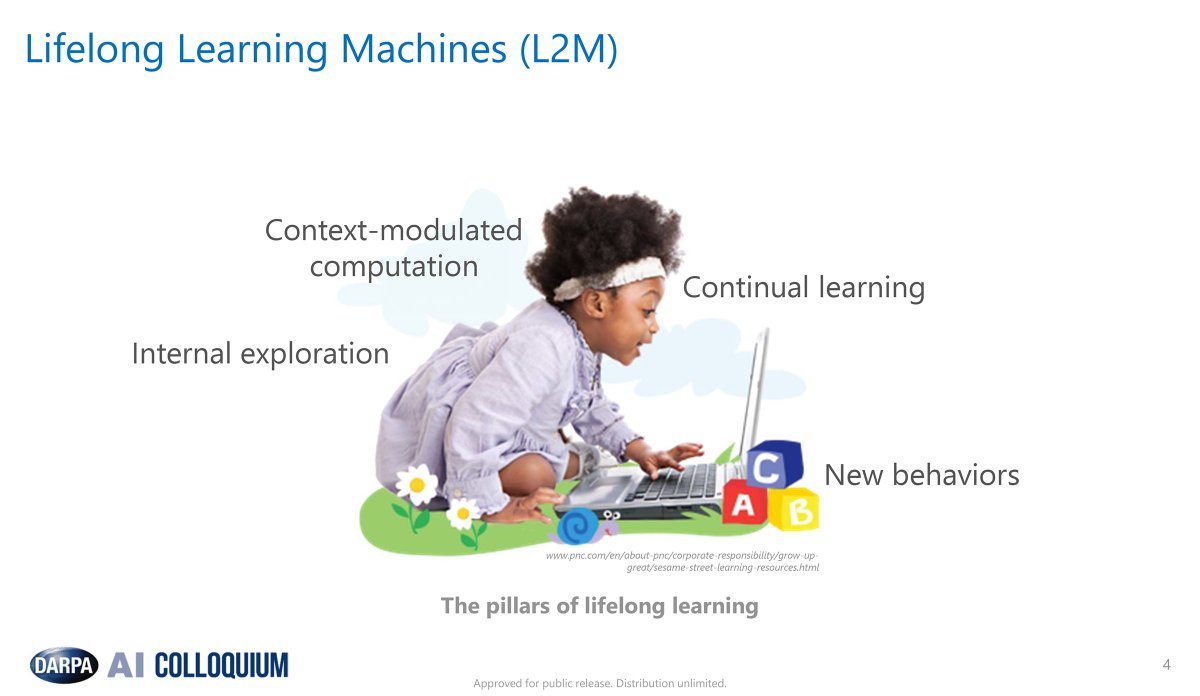
The L2M program, initially announced in 2017, is delving into research and development of next-generation AI systems and their components, together with learning mechanisms in biological organisms capable of translation into computational processes. The goal of the Lifelong Learning Machines (L2M) program is to develop substantially more capable systems that are continually improving and updating from experience. Proposed research should investigate innovative approaches that support key lifelong learning machines technologies and enable revolutionary advances in the science of adaptive and intelligent systems.
The L2M effort currently encompasses a large base of 30 performer groups via grants and contracts of different duration and size.
“We are on the threshold of a major jump in AI technology,” stated Siegelmann. “The L2M program will require significantly more ingenuity and effort than incremental changes to current systems. L2M seeks to enable AI systems to learn from experience and become smarter, safer, and more reliable than existing AI.”