
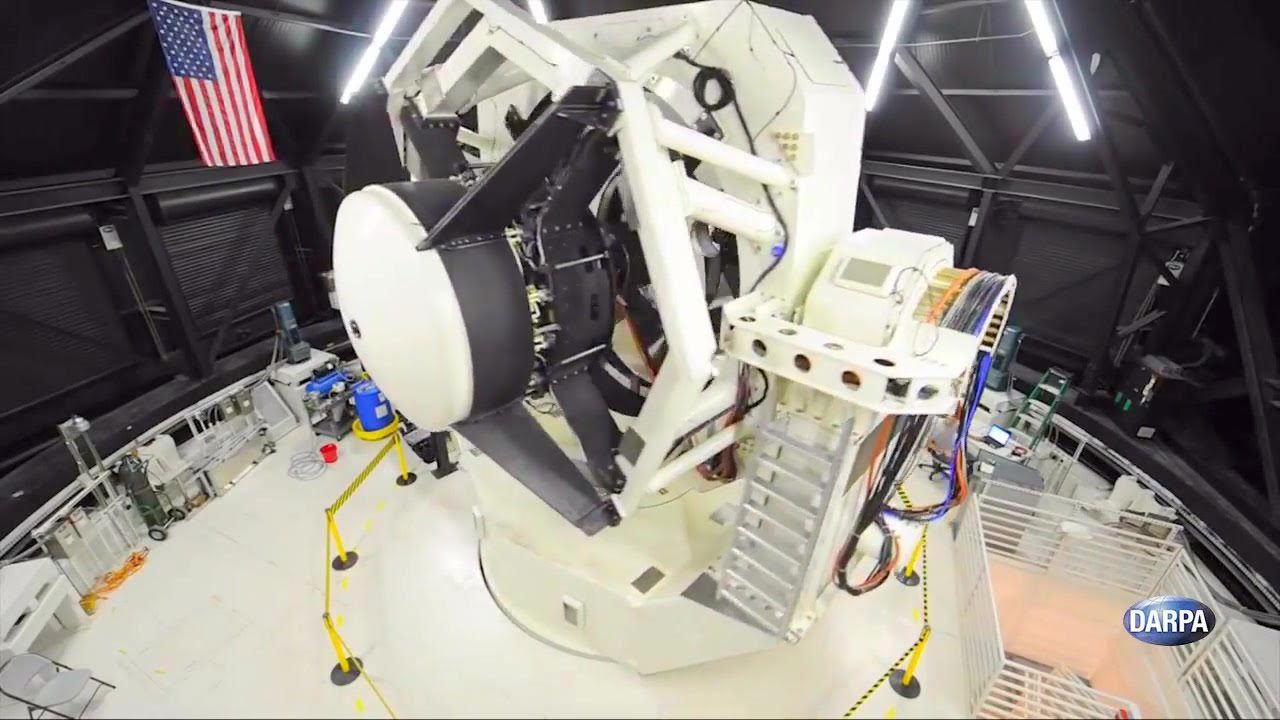

A U.S.-developed space surveillance telescope has been assembled at a new facility in Western Australia and is expected to start operating in 2022, the U.S. Space Force Space and Missile Systems Center announced April 2020. The telescope, designed to track and identify debris and satellites more than 22,000 miles above Earth, was developed a decade ago by the Massachusetts Institute of Technology’s Lincoln Laboratory with funding from the Defense Advanced Research Agency. Between 2011 and 2017 the telescope was tested at the Atom Site on White Sands Missile Range in New Mexico. DARPA handed over the telescope to the U.S. Air Force in 2017.
Pentagon’s DARPA (The Defense Advanced Research Projects Agency) has handed over its Space Surveillance Telescope to the United States’ Air Force Space Command (AFSPC) in New Mexico. The AFSPC plans to transfer its Space Surveillance Telescope to Australia as part of an effort to manage the growing amount of satellite traffic in geosynchronous orbit. It has a beneficial vantage point since it provides important space situational awareness information from the southern hemisphere. The southern hemisphere is a geosynchronous belt that has been sparingly observed until now. After the move, SST will be owned by the United States Air Force, but operated and maintained by Australia. It will be a dedicated sensor in the U.S. Space Surveillance Network (SSN).
The volume of space between the Earth’s surface out to geosynchronous orbit is enormous—equivalent to 240,000 times all the Earth’s oceans. Yet the number of objects calling that volume home is growing all the time—not just with satellites but with debris of all kinds, natural and manmade. And keeping track of it all is becoming a real-time, non-trivial challenge. “That is why the U.S. Department of Defense has made space situational awareness a top priority and why few areas of DARPA research are as important to the future of U.S. and global security as helping to secure this most strategic frontier,” said Dr. Steven Walker, DARPA Deputy Director, at the Transition Ceremony for the Space Surveillance Telescope.
The US Space Surveillance Network (SSN) is the principal system used to detect, track and identify objects orbiting earth. It has the best set of SSA capabilities, operating a global network of 30+ ground based radars and optical telescopes and 2 satellites in orbit. It maintains the most complete tracking database of 23,000+ space objects bigger than 10 cm. SSN largely relies on phased array radars that are also used for early missile warning sensors .The data is fed to the Joint Space Operations Center (JSpOC) in California that provides a range of data and services for US government, satellite operators, and public.
The SSN has fewer telescopes, but they are better distributed geographically. The ground based Electro-optical Deep Space Surveillance System (GEODSS) consists of three separate sensor sites located in New Mexico Hawaii and Diego Garcia in the Indian Ocean. Each site operates a cluster of three telescopes, each of which can be operated independently of each other. Along with these sites there is a mobile site with one telescope located in spain. Together they provide global coverage of the GEO belt, although weather can cause gaps. The SSN however, has little or no coverage in the southern hemisphere or in the South America, Africa and Asia.
The United States and Australia signed an agreement to base the telescope in Australia in an effort to fill a fill a gap in the U.S. Space Surveillance Network coverage of the Southern Hemisphere. The United States shares the SSN network of ground-based sensors with key allies, including Australia. SMC said the telescope last month achieved “first light,” meaning that course alignment of the telescope optics with the wide field of view camera has been completed, allowing the first images of objects in orbit to be seen by the telescope. The Australian government built a new dome for the telescope at the Harold E. Holt Naval Communication Station in Western Australia. The facility has a 2-megawatt central power station. The telescope will undergo tests before entering service in 2022. The Royal Australian Air Force will operate the telescope jointly with the U.S. Space Force’s 21st Space Wing.