
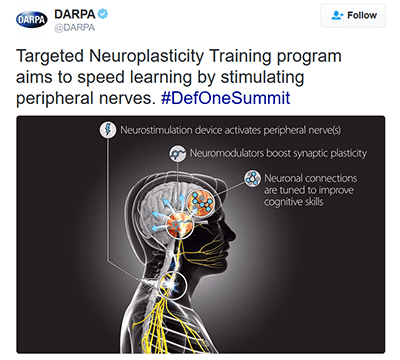

In March 2016, DARPA launched the Targeted Neuroplasticity Training (TNT) program, that seeks to advance the pace and effectiveness of a specific kind of learning—cognitive skills training—through the precise activation of peripheral nerves that can in turn promote and strengthen neuronal connections in the brain. TNT will pursue development of a platform technology to enhance learning of a wide range of cognitive skills, with a goal of reducing the cost and duration of the Defense Department’s extensive training regimen, while improving outcomes.
“Military personnel are required to utilize a wide variety of complex perceptual, motor and cognitive skills under challenging conditions,” said Dr. Robert Rennaker, Texas Instruments Distinguished Chair in Bioengineering, director of the TxBDC and chairman of the Department of Bioengineering. “Mastery of these difficult skills, including fluency in foreign language, typically requires thousands of hours of practice,” said Rennaker, who served in the U.S. Marine Corps. DARPA’s TNT program aims to develop an optimized strategy to accelerate acquisition of complex skills, which would significantly reduce the time needed to train foreign language specialists, intelligence analysts, cryptographers and others.
That kind of neural tuning can “influence cognitive state—how awake you are, or how much attention you’re paying to something you’re viewing or performing,” says Doug Weber, a bioengineer at DARPA who heads up the TNT project. If it works—if researchers can improve a person’s ability to learn—the DoD could reduce the amount of time spent training soldiers and intelligence agents. “Foreign language training is one of our primary application areas because it’s very time intensive,” says Weber. Language courses last more than a year, and only about 10 percent of trainees reach the level of proficiency needed for their jobs, he says.
Weber says he envisions intelligence agents or soldiers wearing some kind of noninvasive stimulation device that delivers precise electrical pulses as they practice their skills. And unlike caffeine or energy drinks, the stimulation can be turned off and, hopefully, causes fewer side effects.