

Modern expeditionary military missions generate and exchange massive amounts of data that are used to produce situational awareness and guide decision-making. Much of the data must travel long distances along backbone communications networks composed of high-capacity links that connect command centers.
Fiber optic cables provide the core backbone for military and civilian networks, enabling Internet, phone, video and other data to move at super-high speeds with virtually no degradation over long distances. In deployed environments, where a fiber optic backbone doesn’t exist, other communications modes are used resulting in reduced data-rate capacity for the warfighter. Satellite Communications (SATCOM) services can provide some capacity to remote areas but cannot provide the capacity needed to support the amount of data generated by emerging ISR systems.
Free-space optical (FSO) links using laser communications is another option to project data at such speeds. FSO links have been shown to have fiber-optic-equivalent capacity at long ranges and are expected to play a significant role in the military’s airborne-based data backbone. Still, today’s FSO link technology cannot propagate through clouds, which are present 40 percent of the time in some regions and lead to unacceptable network availability, DARPA researchers point out. Instead, high-speed radio frequency (RF) links may be the best solution.
To provide high bandwidth connections to soldiers, DARPA is developing millimeter wave communication. The Programs sought to capitalize on the technology base already initiated by the allocation of the E-Band ( 71 – 86 GHz) spectrum. The total spectral bandwidth available consisting of 5GHz spectrum at each of two bands 71-76 GHz and 81-86GHz exceeds that of all allocated bands in the microwave spectrum. With such wide bandwidth available, millimeter wave wireless links can achieve capacities as high as 10 Gbps full duplex, which is unlikely to be matched by any lower frequency RF wireless technologies.
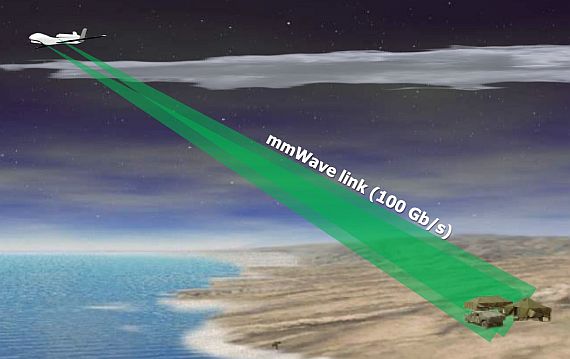
DARPA is developing 100 Gb/s RF Backbone (100G) program whose goal is to design, build, and test an airborne based Millimeter based RF communications link with fiber-optic equivalent capacity and long reach capable of propagating through clouds and providing high availability.The system will provide 100 Gb/s capacity at ranges of 200 km for air-to-air links and 100 km for air-to-ground links when installed in a high-altitude (e.g. 60,000 ft) aerial platform.