
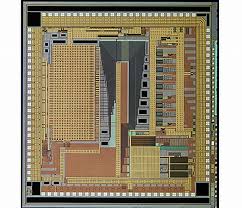

Demand for specialized integrated circuits for military electronics continues to surge exponentially with no end in sight. Systems that synchronize the activity of unmanned aerial vehicles; real-time conversion of raw radar data into tactically useful 3-D imagery; and instant access to high-resolution sensor feeds on the battlefield are only three examples of this reality. Despite the importance of these capabilities to national security, however, current circuit-design methods often result in devices that require more power than can be practically supplied on small flying platforms or on warfighters already burdened by too much battery weight.
It’s not that engineers are incapable of designing custom integrated circuits that can perform a specific task with optimum power efficiency. It is, rather, that they are today stymied by the prospect of spending up to $100 million and working for more than two years to complete such a design. As a result, Defense Department engineers often turn to more generic, inexpensive, and readily available general-purpose circuits, and then rely on software to make those circuits run the required specialized operations. Using general-purpose circuits can speed up design and implementation, but also burdens electronic systems with unnecessary power-gobbling circuitry. DARPA launched new Circuit Realization At Faster Timescales (CRAFT) program in 2015, with goals to reduce by 10X the effort required to design and verify complex SoCs in leading edge CMOS technology and to reduce by 5X the effort required to port designs to a new fabrication process.
“This dilemma has reduced the use of custom-integrated circuits and, consequently, the performance of DoD systems,” according to BAA of the three-phase program, Circuit Realization At Faster Timescales (CRAFT), that was slated to last just over three years with total funding of about $30 million. Overseen by Linton Salmon, a program manager in DARPA’s Microsystems Technology Office (MTO), the CRAFT program seeks to develop new fast-track circuit-design methods, multiple sources for integrated circuit fabrication, and a technology repository that will facilitate reuse of proven solutions.
Reducing the time and cost for designing and procuring custom, high-efficiency integrated circuits, should drive more of those in the DoD technology community toward best commercial fabrication and design practices,” CRAFT program manager, Dr. Linton Salmon in a program information release. “A primary payoff would be a versatile development environment in which engineers and designers make decisions based on the best technical solutions for the systems they are building, instead of worrying about circuit design delays or costs.”
Many systems could benefit from advances of the sort that CRAFT seeks to catalyze. Consider, for example, the data- and computation-intensive “Gotcha” radar system that the Air Force Research Laboratory is developing to identify moving objects over city-scale areas and render detailed 3-D imagery. “Gotcha currently requires a land-based supercomputer to make sense of the radar data and convert it into tactically useful imagery. However, relaying the data to a remote supercomputer across a contested data link can cause crippling delays,” Salmon explained. “The CRAFT program could help put more of the necessary computational power on the UAV itself or on the backs of warfighters, enabling quicker delivery of the imagery to those who need it most.”