

The growth of the internet-of-things (IoT) and network-connected composed systems (e.g., aircraft, critical-infrastructure, etc.) has led to unprecedented technical diversity in deployed systems. From consumer IoT devices developed with minimal built-in security, which are often co-opted by malware to launch large distributed denial of service (DDoS) attacks on internet infrastructure, to remote attacks on Industrial Control System (ICS) devices, these newly connected, composed systems provide a vast attack surface.
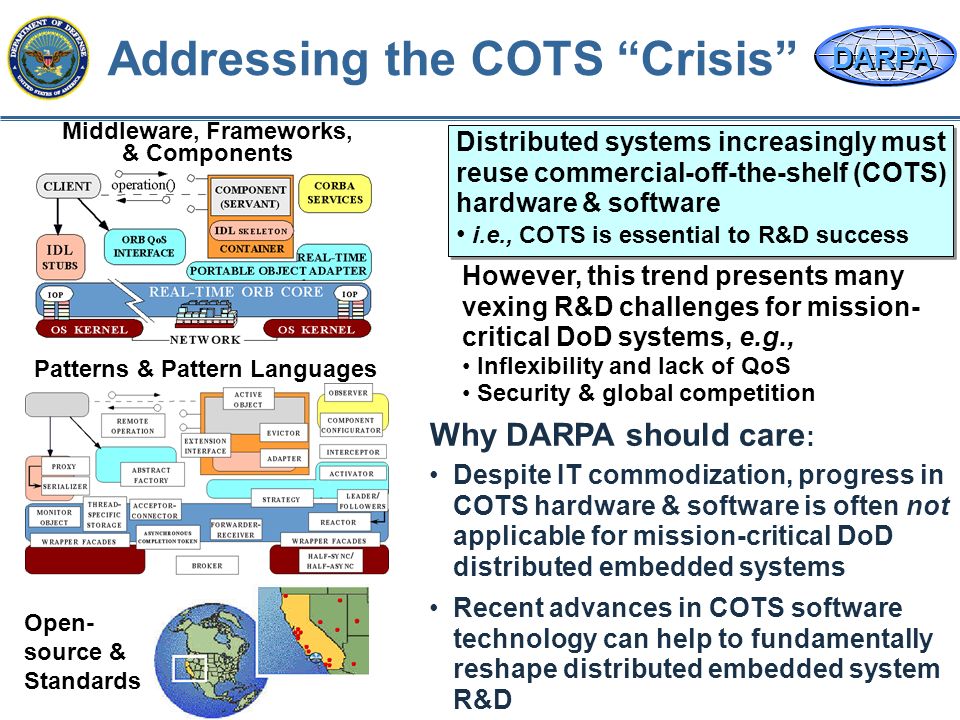
While the diversity of functionality and the scope of what can now be connected, monitored, and controlled over the network has increased dramatically, economies of scale have decreased platform diversity. More and more consumer, industrial, and military players are turning to inexpensive, commodity off-the-shelf (COTS) devices with general-purpose designs applicable for a range of functionalities and deployment options to replace single-purpose, custom devices. For example, the central processing unit (CPU) market has consolidated on ARM, x86 and stream processors.
While less costly and more flexible, commodity components are inherently less secure than the single-purpose, custom devices they are replacing. “With commodity devices, software and configuration settings now govern behaviors that were physically impossible in special-purpose hardware, creating security risks and increasing system vulnerability,” said Jacob Torrey, program manager in DARPA’s Information Innovation Office (I2O).
“Certain functionality built into COTS components may not be necessary for all users or applications, and unwanted functionality can be hard to detect and turned-off. For instance, an unneeded maintenance or diagnostic service left enabled could create an opportunity for an attacker to circumvent other security controls and use the system’s as-deployed functionality to generate a malicious effect. This opaqueness is creating challenges for system operators who must rely on component configurations to reduce attack surfaces created by unnecessary functionality.”
To address the challenges created by the proliferation of COTS devices and help harden the security surface of network-connected composed systems, DARPA has launched a new program called Configuration Security (ConSec). The program, aims to develop a system to automatically generate, deploy, and manage inherently more secure configurations of components and subsystems for use in military platforms.
“Through ConSec we hope to gain a better understanding of the available functionality across COTS devices and what’s needed for the task at hand and then use system configurations to create the functionality that’s actually required while minimizing the excess that can be used as an attack surface,” said Torrey. “While our objective is to build this capability for military platforms, there is the potential for the program to have broader applications for commercial and industrial systems as well.”