

The first Wave of AI is Crafted Knowledge, which includes rule-based AI systems. In the first wave,humans defined the rules for the Intelligent machines and they follow the rules. The second wave of AI is Statistical Learning, which includes machine becoming intelligent by using statistical methods. This includes all machine learning techniques that relying on the machines to define rules by clustering, classifications and use those models to predict and make decisions.
DARPA-funded projects enabled some of the first successes in AI, such as expert systems and search, and more recently the agency has advanced machine learning algorithms and hardware. Machine learning (ML) methods have demonstrated outstanding recent progress and, as a result, artificial intelligence (AI) systems can now be found in myriad applications, including autonomous vehicles, industrial applications, search engines, computer gaming, health record automation, and big data analysis.
But the problem with deep learning is that it is a black box, which means it is very difficult to investigate the reasoning behind the decisions it makes. The opacity of AI algorithms complicates their use, especially where mistakes can have severe impacts. For instance, if a doctor wants to trust a treatment recommendation made by an AI algorithm, they have to know what is the reasoning behind it. The same goes for a judge who wants to pass sentence based on recidivism prediction made by a deep learning application. These are decisions that can have a deep impact on the life of the people affected by them, and the person assuming responsibility must have full visibility on the steps that go into those decisions, says David Gunning, Program Manager at XAI, DARPA’s initiative to create explainable artificial intelligence models.

Current artificial intelligence (AI) systems only compute with what they have been programmed or trained for in advance; they have no ability to learn from data input during execution time, and cannot adapt on-line to changes they encounter in real environments.
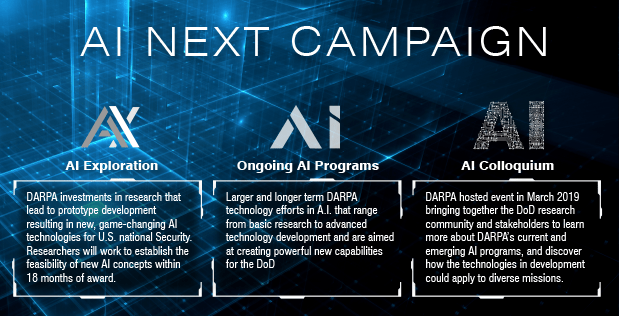
DARPA is now interested in researching and developing “third wave” AI theory and applications that address the limitations of first and second wave technologies by making it possible for machines to contextually adapt to changing situations. In the third wave, instead of learning from data, intelligent machines will understand and perceive the world on its own, and learn by understanding the world and reason with it. The agency’s diverse portfolio of fundamental and applied AI research programs is aimed at shaping a future in which AI-enabled machines serve as trusted, collaborative partners in solving problems of importance to national security.

Experts also point to the Fourth Wave of AI will be an advancement of the third wave, but beside of adapting to the world, the AI can have common sense and understand ethics. In this area, the machine doesn’t only learn from the environment but also can make decisions based on ethics, regulations, and law to avoid misuse.
AIE Opportunities will focus on “third wave” theory and applications of AI. We see this third wave is about contextual adaptation, and in this world we see that the systems themselves will over time build underlying explanatory models that allow them to characterize real-world phenomena,” John Launchbury, director of DARPA’s Information Innovation Office, said in a video.
Another DARPA’s many exciting projects is Explainable Artificial Intelligence (XAI), an initiative launched in 2016 aimed at solving one of the principal challenges of deep learning and neural networks, the subset of AI that is becoming increasing prominent in many different sectors. “XAI is trying to create a portfolio of different techniques to tackle [the black box] problem, and explore how we might make these systems more understandable to end users. Early on we decided to focus on the lay user, the person who’s not a machine learning expert,” Gunning says.
The problem will become further risky as humans start to work more closely with robots, in collaborative tasks or social or assistive contexts, as it will be hard for people to trust them if their autonomy is such that we find it difficult to understand what they’re doing. In a paper published in Science Robotics, researchers from UCLA have developed a robotic system that can generate different kinds of real-time, human-readable explanations about its actions, and then did some testing to figure which of the explanations were the most effective at improving a human’s trust in the system. This work was funded by DARPA’s Explainable AI (XAI) program, which has a goal of being able to “understand the context and environment in which they operate, and over time build underlying explanatory models that allow them to characterize real world phenomena.”