
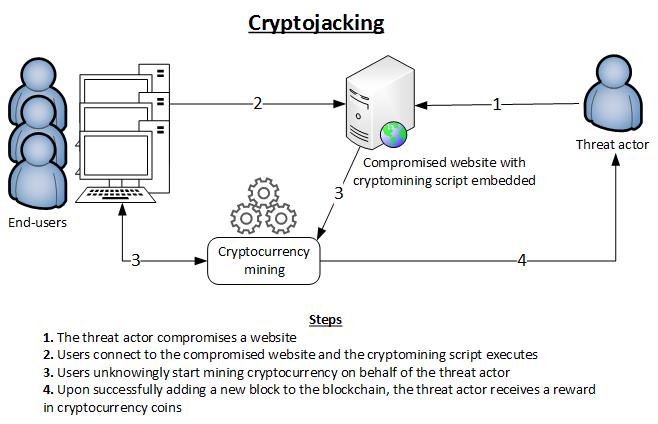

Cyber criminals are switching away from ransomware to stealthier attacks as the main sources of generating revenue, according to analysis by British artificial intelligence (AI)-based cyber security firm Darktrace. Cryptojacking is the unauthorized use of someone else’s computer to mine cryptocurrency. Cryptocurrency is a form of digital currency that can be used in exchange for goods, services, and even real money. Users can “mine” it on their computer by using special programs to solve complex, encrypted math equations in order to gain a piece of the currency.
Coin mining on your own can be a long, costly endeavor. Elevated electricity bills and expensive computer equipment are major investments and key challenges to coin mining. The more devices you have working for you, the faster you can “mine” coins. Because of the time and resources that go into coin mining, cryptojacking is attractive to cybercriminals. In a sense, cryptojacking is a way for cybercriminals to make free money with minimal effort. Cybercriminals can simply hijack someone else’s machine with just a few lines of code.
This leaves the victim bearing the cost of the computations and electricity that are necessary to mine cryptocurrency. The criminals get away with the tokens. Hackers do this by either getting the victim to click on a malicious link in an email that loads crypto mining code on the computer, or by infecting a website or online ad with JavaScript code that auto-executes once loaded in the victim’s browser.
Either way, the crypto mining code then works in the background as unsuspecting victims use their computers normally. Whichever method is used, the code runs complex mathematical problems on the victims’ computers and sends the results to a server that the hacker controls. The only sign they might notice is slower performance or lags in execution.
The Ukranian cyber police say that they have arrested an unnamed person who infected numerous of his websites with malware such as ‘Wannacry.’ He infected his own websites by putting crypto mining malware scripts into it; local law enforcement of Ukraine reported the matter on March 2019. An unnamed 32-year-old man has been caught by the cyber-crime unit of the Ukraine national police from the region of Bukovina who, apparently, put cryptojacking software over a number of educational websites which were developed and administered by him. The unidentified websites and the internet resources were visited by around 1.5 million users every month, the cyber-crime police mentioned.
Cryptojacking malware and ransomware activities have increased rapidly, the cybersecurity firm McAfee Labs revealed in the month of December 2018 , that the overall occurrences of cryptojacking malware grew by more than 4,000 percent in the year 2018.