
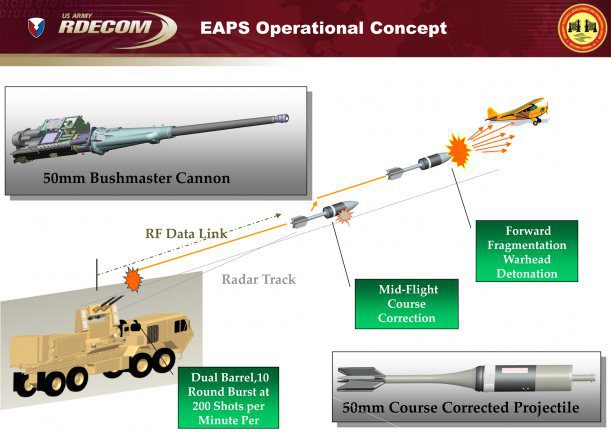

As the threat for Rocket, Artillery, and Mortar (RAM) increases around the world, the need for a system to detect
and alert Soldiers of incoming rounds for military locations becomes vital to mission success and force survivability. Military installations such as forward operating bases are vulnerable to rocket, artillery and mortar (RAM) attacks – a threat that also extends to civilian infrastructure in many parts of the world. Indeed, such weapons have become tools of choice in asymmetric conflicts, with militants carrying out attacks with ever-smaller, ever-more effective projectiles – with little or no warning and often launched from built-up areas
The C-RAM capability (which comprises of multiple sensors, C2 nodes and warning systems) is an essential capability to protect friendly forces from hostile fire by detecting and warning against small, mobile and hard-to-find threats such as rockets, artillery and mortar fire. Counter Rocket, Artillery, and Mortar, abbreviated C-RAM or Counter-RAM, is a set of systems used to detect and/or destroy incoming artillery, rockets and mortar rounds in the air before they hit their ground targets, or simply provide early warning. C-RAM is made up of variety of systems which provide the ability to sense, warn, respond, intercept, command and control, shape, and protect deployed forces.
US’s Counter-Rocket, Artillery, Mortar (C-RAM) / Indirect Fire Protection Capability (IFPC) system was developed early during Operation Iraqi Freedom/Enduring Freedom in order to protect ground forces and forward operating bases from the threat of rockets, artillery, and mortars. C-RAM was operationally deployed in Iraq and Afghanistan, where its sense and warn capabilities provided timely warning of more than 2,500 rocket and mortar attacks against C-RAM equipped forward operating bases. C-RAM was also purchased by Australia and the United Kingdom. The system has been credited with saving thousands of soldiers’ lives.
Iron dome is an Israeli missile system featuring multiple-target tracking and self-guided missile interceptors. Prime minister Benjamin Netanyahu commended the teams operating the Iron Dome missile defense system in Nov 2019, saying they had set a new standard by intercepting more than 90% of rockets launched from Gaza towards Israeli civlian population centers.
The summer of 2014 saw Hamas’s armed wing, the al-Qassam Brigades carrying out its deepest rocket strike, reaching about 160 km from the Gaza Strip. Israel launched its military offensive Operation Protective Edge with the declared objectives of stopping Hamas firing rockets from Gaza into Israel, find and destroy Hamas’s rocket stores. Israel’s Iron Dome system had intercepted over 400 rockets fired into Israel by Gaza Strip militants. Based on operational success, defense reporter Mark Thompson estimates that Iron Dome is currently the most-effective and most-tested counter missile system in existence.
In Russia, considerable development effort has been invested since 1992 to develop Counter Precision Guided Munition (C-PGM) weapon systems aiming to shoot them down using short range SAM-fire or gunfire.
C-RAM systems are now being upgraded to handle other threats including enemy drones, helicopters, fixed-wing aircraft and cruise missiles. The future trend is to upgrade laser directed energy weapons for counter -RAM role. Kratos Defense & Security Solutions has secured a new $29m contract to support the US Army’s Directed Energy (DE) systems. The company will commit to developing prototype technologies, components and subsystems to support the advancement and upgrade of the existing or new DE systems. It will help expand the DE system capabilities of counter rocket, artillery and mortar (C-RAM), counter unmanned aircraft systems (C-UAS), and / or counter intelligence, surveillance, reconnaissance (C-ISR) missions.
Laser weapons, especially electrically pumped lasers, that offer exceptionally low cost per shot, and almost unlimited ‘magazine depth’, are attractive solution for C-RAM application. This advantage must be balanced against higher procurement costs and the need to ‘dwell’ the weapon on a target until burn-through of the skin or casing can be effected. The latter will be an issue for defeating saturation attacks. The inability of lasers to penetrate cloud, haze, dust and fog is another unavoidable limitation.
https://www.youtube.com/watch?v=kvaXUXuRapw