
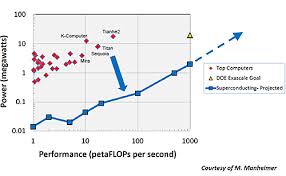

Today, silicon microchips underlie every aspect of digital computing. Now Moore’s Law is stuttering, and the world’s supercomputer builders are confronting an energy crisis. But those big gains using silicon seem to have ended, with the high-end Intel Core i7 chips, for instance, have been on computer store shelves for nearly a decade. And as supercomputers grow bigger, so too does their energy consumption. The world’s fastest known supercomputer today, China’s 34-petaflop Tianhe-2, consumes some 18 megawatts of power. That’s roughly the amount of electricity drawn instantaneously by 14,000 average U.S. households. Similarly, Summit the world’s most powerful computer – a 200-petaflop behemoth at the Oak Ridge National Laboratory in Tennessee, needs more than 17,000 litres of water every minute to keep it running safely. Even with the latest cooling technology, which uses water to remove waste heat, it’s tricky for engineers to keep the processor at the right operating temperature. The next race is for exascale supercomputers, capable of 1,000 petaflops—1 million trillion floating-point operations per second—or greater. Some estimates to reach exascale supercomputing are in the hundreds of megawatts.
By 2040, the world’s computers may need more electricity than our global energy production can deliver, according to a report released by the Semiconductor Industry Association and the Semiconductor Research Corporation in 2015. Therefore researchers are searching for the innovative ways to stop such devices guzzling so much energy. A computer based on superconducting logic and cryogenic memory can help solve these issues.
In 1911, a Dutch scientist discovered a class of materials which, at temperatures near absolute zero, could conduct electricity with no resistance and therefore zero loss of power. These materials called Superconductors have unique properties including, Zero resistance to direct current; Extremely high current carrying density; Extremely low resistance at high frequencies; Extremely low signal dispersion; High sensitivity to magnetic field; Exclusion of externally applied magnetic field; Rapid single flux quantum transfer; and Close to speed of light signal transmission. In theory, the system results in almost zero resistance and would require just a fraction of the energy of traditional computers, from one-fortieth to one-thousandth depending on the estimate.
The superconducting computer could be one of the most radical solutions to an ever-increasing energy demand. The concept rests on sending electric currents through supercooled circuits made of superconducting materials. After the second world war, the United States, the former Soviet Union, Japan and some European countries tried to build large-scale, cryogenically cooled circuits with low electric resistance.
Superconducting supercomputers was first inspired by the electrical engineer Dudley Buck. He built a novel superconducting switch he named the cryotron. The device works by switching a material between its superconducting state—where electrons couple up and flow as a “supercurrent,” with no resistance at all—and its normal state, where electrons flow with some resistance. A number of superconducting metallic elements and alloys reach that state when they are cooled below a critical temperature near absolute zero. Once the material becomes superconducting, a sufficiently strong magnetic field can drive the material back to its normal state.
Buck developed a digital switch by coiling a tiny “control” wire around a “gate” wire, and plunged the pair into liquid helium. When current ran through the control, the magnetic field it created pushed the superconducting gate into its normal resistive state. When the control current was turned off, the gate became superconducting again. Buck thought miniature cryotrons could be used to fashion powerful, fast, and energy-efficient digital computers. But liquid-helium temperatures made cryotrons challenging to work with, and the time required for materials to transition from a superconducting to a resistive state limited switching speeds.
IBM’s superconducting supercomputer program ran for more than 10 years, at a cost of about US $250 million in today’s dollars. It mainly pursued Josephson junctions made from lead alloy and lead oxide. Late in the project, engineers switched to a niobium oxide barrier, sandwiched between a lead alloy and a niobium film, an arrangement that produced more-reliable devices.
Josephson junction is switch based on the Josephson effect. Josephson predicted that if the insulating barrier between two superconductors is thin enough, a supercurrent of paired electrons could flow across with zero resistance, as if the barrier were not there at all.
Inspired by IBM’s project, Japan’s industrial ministry, MITI, launched a superconducting computer effort in 1981. The research partnership, which included Fujitsu, Hitachi, and NEC, lasted for eight years and produced an actual working Josephson-junction computer—the ETL-JC1. It was a tiny, 4-bit machine, with just 1,000 bits of RAM, but it could actually run a program. In the end, however, MITI came to share IBM’s opinion about the prospect of scaling up the technology, and the project was abandoned.
In 1983, Bell Telephone Laboratories researchers formed Josephson junctions out of niobium separated by thin aluminum oxide layers. The new superconducting switches were extraordinarily reliable and could be fabricated using a simplified patterning process much in the same way silicon microchips were.
Then in 1985, researchers at Moscow State University proposed a new kind of digital superconducting logic. Originally dubbed resistive, then renamed “rapid” single-flux-quantum logic, or RSFQ, it took advantage of the fact that a Josephson junction in a loop of superconducting material can emit minuscule voltage pulses. Integrated over time, they take on only a quantized, integer multiple of a tiny value called the flux quantum, measured in microvolt-picoseconds.
China is latest entry whose aim is to have a prototype of the machine up and running as early as 2022, according to a programme quietly launched by the Chinese Academy of Sciences (CAS) in November 2017 last year with a budget estimated to be as much as one billion yuan.
Supercomputers remain indispensable for the maintenance of a nuclear deterrent and the design of nuclear weapons through “virtual nuclear tests”. Supercomputers have helped Russia and China develop and deploy an entirely new generation of nuclear weapons, again without testing. Exascale computers are also required by Intelligence agencies like NSA and GCHQ for counter terrorism operations. They are also essential for Cybersecurity.