
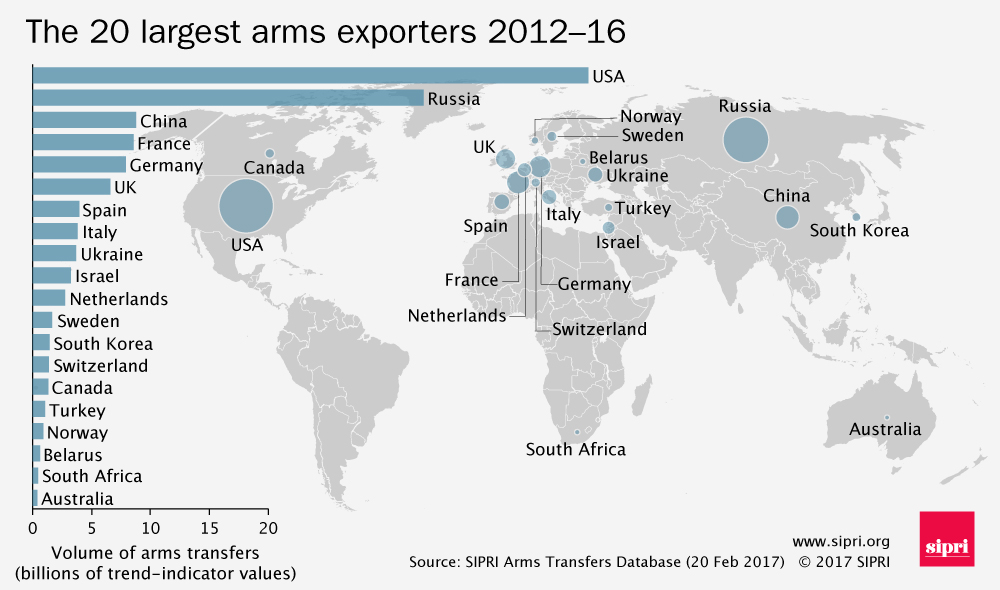

The United States remains the world’s top weapons seller, accounting for 34 percent of global arms sales over the past five years. Russia was the second-largest exporter with about 20 percent of all global arms deliveries, the Stockholm International Peace Research Institute (SIPRI) reported on March 11 in its latest overview of global weapons transfers.
The U.S. share of arms sales is up from 30 percent recorded in the 2008-12 period, SIPRI said. “Based on deals signed during the Obama administration, U.S. arms deliveries in 2013–17 reached their highest level since the late 1990s,’ said Aude Fleurant, director of the SIPRI Arms and Military Expenditure Program. U.S. arms went to at least 98 countries, with a large portion of U.S. exports consisting of combat and transport aircraft, SIPRI said.
Russia was the world’s second biggest arms exporter across 2012–16. The research group said Russia exported weapons to 47 countries as well as to rebel forces in eastern Ukraine, where Moscow-backed separatists are fighting the central government in Kyiv. But 70 per cent of those sales relied on just four countries — India, Vietnam, China and Algeria. Overall, Russian arms sales fell 7 percent from the previous five-year period.
China’s share of global arms exports rose from 3.8 percent to 6.2 percent from 2012 to 2016 as the country became the third-largest weapon supplier in the world after the U.S. and Russia. China’s arms exports have been criticized for lacking global appeal since 72 per cent of all exports in the last five years went to just three countries: Pakistan, Bangladesh and Myanmar.
China has been successful in diversifying its customer base and now exports arms to 55 countries worldwide, covering Asia, the Middle East, Africa and Latin America. Many of China’s clients are indeed developing countries. For example, two-thirds of the countries situated in the world’s poorest continent, Africa, procure weapon systems from China, and much of it is basic military equipment.
Israel is the 7th largest exporter of weapons in the world, according to the SIPRI report. Over the past five years, the export of Israeli weapons systems climbed by 55 percent compared to the five years that preceded it, which is the biggest increase among the top 10 arms exporters. Almost half (49%) of Israeli weapons exported from 2013 to 2017 went to India, 13% to Azerbaijan and 6.3% to Vietnam. Israel is also the third-largest arms provider for South Korea, Italy and Britain.
In January, the Australian government launched its new Defence Export Strategy, which aims to turn Australia into one of the world’s top 10 arms exporters. The strategy will raise government assistance for arms exports, making Australia more like Britain and other major arms-exporting states.