

The warning bells has ringed in US, as Kim has finally succeeded in developing an ICBM operational capability through which it can deliver a nuclear weapon anywhere in the United States, according to analysis based on Images released by North Korea. North Korea released dozens of photos and a video after 29 Nov launch of the new Hwasong-15 missile, and leader Kim Jong Un declared the country had “finally realized the great historic cause of completing the state nuclear force”.
North Korea said the missile soared to an altitude of about 4,475 km (2,780 miles), more than 10 times the height of the International Space Station, and flew 950 km (590 miles) during its 53-minute flight before landing in the sea near Japan. In response, US is strengthening its Ballistic Missile Defence capabilities including the Redesigned Kill Vehicle, the Multi-Object Kill Vehicle, the Configuration-3 booster, a space-based sensor layer, boost phase sensor and kill technologies and additional ground-based interceptors.”
In its 2019 Missile Defense Review, the Department of Defense calls for “space-basing,” or putting sensors and interceptors in orbit to detect and defeat attacks as early as possible. The National Defence Authorisation Act, a year-end policy bill also hinted that US will seek to use advanced technology to defeat both small-scale and large-scale nuclear attacks through “research, development, test and evaluation” of space-based systems for missile defence. The US exchanges missile detection and warning information with its multinational partners.
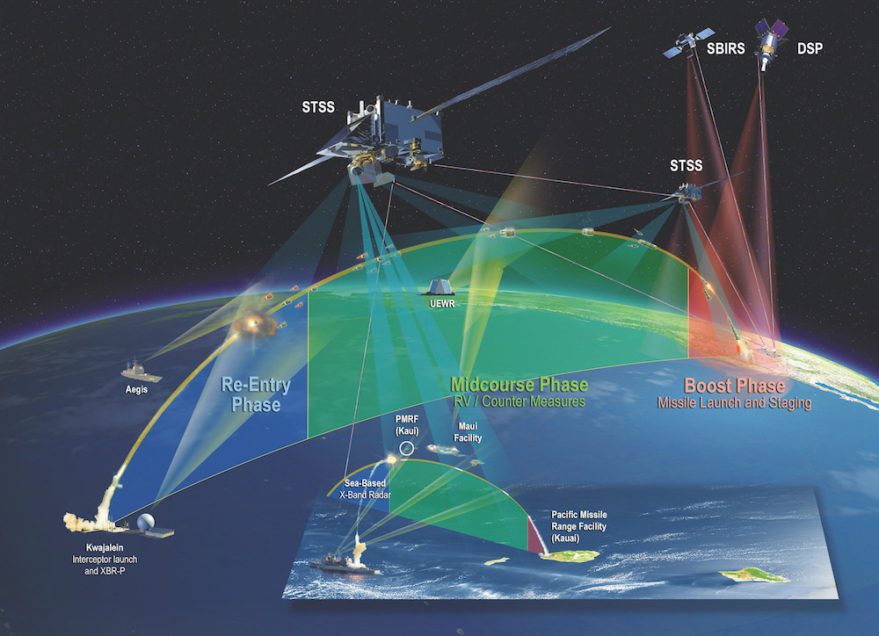
Critical to space and missile defence is capability of well-organized missile warning system structure that allows commanders to maximize detection and warning of inbound ballistic missiles, thereby ensuring effective passive defense, active defense, and attack operations. Missile warning systems process raw sensor data into missile warning reports and disseminate the information to users globally. Missile warning consists of multiple ground and space-based systems located worldwide.
The Pentagon’s new Missile Defense Review highlights new space capabilities that could become the next layer of missile defense to deal with the threat of ballistic missile threats posed by North Korea and Iran. But while the earlier review focused exclusively on the ballistic-missile threat, the new review broadens the scope to include cruise missile and hypersonic threats being developed by Russia and China. A key point of emphasis in the review will be space-based capabilities that could help the U.S. stay ahead of the threat, according to the official.
The American missile warning mission uses a mix of space-based and terrestrial sensors. US’s Space-based Infrared System (SBIRS) is a constellation of integrated satellites in geosynchronous orbit (GEO) and high elliptical orbit (HEO) and ground-based data processing and command and control centers.This system is designed to provide early missile warning, cue missile defenses, deliver technical intelligence (TECHINT), and support battlespace awareness. These satellites are equipped with IR sensors that track the hot plumes of the launches.
Lockheed Martin has been awarded nearly $163.9 million for support of the space-based infrared system (SBIRS). The US Air Force’s (USAF) fourth Space-Based Infrared System (SBIRS) Geosynchronous Earth Orbit (GEO) satellite sent its first set of images back to Earth in May 2018. Known as ‘first light’, the event occurred when the SBIRS GEO Flight-4 missile-warning satellite turned on its powerful sensors for the first time during space vehicle checkout. Developed by Lockheed Martin, the SBIRS GEO Flight-4 is the latest satellite to join the USAF’s orbiting missile warning constellation.
The SBIRS will eventually be replaced by the Pentagon’s Next Gen Overhead Persistent Infrared satellites, which will include large GEO satellites and cheaper, smaller satellite operating in low earth orbit, the Air Force’s Space and Missile System Center confirmed.
ABC News has learned that another space technology that might be explored is the development of a space-based interceptor that could fire rockets into space, directed at an incoming missile. The Missile Defense Review also calls for the study of whether to use “directed energy” against incoming missiles, possibly through laser technology, according to the official. However, 2003 study by the American Physical Society concluded that a system of space-based interceptors designed to defeat boosting enemy missiles “would require a fleet of a thousand or more orbiting satellites just to intercept a single missile.”
Russia and China are also pursuing space based missile defence solutions. Russian President Vladimir Putin says Moscow is helping China build a system warning about ballistic missile launches. Since Cold War times, only the United States and Russia have had such systems, which involve an array of ground-based radars and space satellites. The system is essential for early spotting of intercontinental ballistic missiles. Speaking at an international affairs conference Thursday, Putin said that Russia has been helping China develop such a system. He added that “this is a very serious thing that will radically enhance China’s defense capability.”