
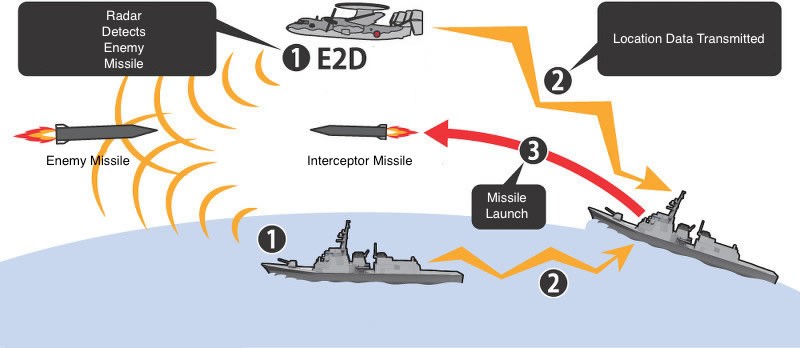

Cooperative Engagement Capability (CEC) is a sensor network with integrated fire control capability that is intended to significantly improve battle force air and missile defense capabilities by combining data from multiple battle force air search sensors on CEC-equipped units into a single, real-time, composite track picture (network-centric warfare). This will greatly enhance fleet air defense by making jamming more difficult and allocating defensive missiles on a battle group basis.
CEC is intended to (1) net the sensors of a force together in a manner that maximizes their effectiveness at maintaining a continuous track on all aircraft and missiles in the area of interest and, when necessary, (2) enable one unit to provide fire control quality information to another unit when the shooter is unable to track the threat with local sensors.
Against the most stressing threat aircraft and anti-ship missiles, CEC expands the battlespace significantly. By providing a continuous track on these air threats from their initial detection, CEC gives the commanding officer minutes instead of seconds to identify and engage the threat.
US Navy’s Cooperative Engagement Capability (CEC) is a real-time sensor netting system that enables high quality situational awareness and integrated fire control capability. CEC is designed to enhance the anti-air warfare (AAW) capability of U.S. Navy ships and U.S. Navy aircraft by the netting of geographically dispersed sensors to provide a single integrated air picture, thus enabling Integrated Fire Control to destroy increasingly capable threat cruise missiles and aircraft.
Cooperative engagement also applies to ship-based protective features where Aegis radars of guided missile cruisers and destroyers are linked together into a single network to share data as a whole. This allows targets detected by one ship, as well as those seen by aircraft, to be identified by another ship and fired upon with long-range missiles like the Standard Missile 6 (SM-6) without that vessel having to actually detect it themselves. Not needing to fire on targets only once a ship’s own sensors see them allows for shorter time needed to shoot, increased standoff distance to begin firing, and enables a whole fleet to intercept threats, like high-speed cruise missiles, once only a single ship sees them.
The Royal Australian Navy (RAN) and U.S. Navy for the first time have jointly conducted a test of the so-called cooperative engagement capability (CEC) real-time sensor netting system off the coast of Hawaii, Australian Defense Minister Christopher Pyne announced in a November 2018 statement.
“Connecting and sharing data with the US Navy like this is an important step in increasing our interoperability with them, especially during linked task group operations at sea,” the commanding officer of the Hobart, Captain John Stavridis, said. “Sharing information like this between ships at sea means that ships in a task group can know and respond to what is going on, including sharing tracking and targeting data.”
On 15 May 2019, the Indian Navy became the second service in the world after the United States, & the first in Asia, to have developed the capability, by conducting the maiden cooperative engagement firing of the Barak 8. The IN said the co-operative engagement firing capability it has demonstrated will give it an operational flexibility similar to that fielded by the US and French navies.
The Japanese Ministry of Defense has decided to develop its own “cooperative engagement capability” (CEC) system that would enable Self-Defense Force (SDF) units to share enemy information in real time such as locations and carry out joint counterattacks against enemy weapons such as cruise missiles, according to ministry officials.
The ministry included 6.9 billion yen in its budget request for fiscal 2019 to conduct research aimed at developing high-speed, high-capacity communications devices necessary for a CEC system. The ministry wants to complete a prototype system by fiscal 2022, and begin operational tests aboard Maritime Self-Defense Force (MSDF) destroyers in fiscal 2023. Eventually, the ministry intends to upgrade SDF aircraft with the Japanese CEC equipment and operate them along with new destroyers using an American equivalent system.