

Electronics has revolutionized our society by providing many devices e.g. laptops, palm pilots, digital cameras, household robots, etc. Every electronic system or device needs electric power to operate, whether it is from walled AC supply or a battery. This electric power cannot be stored infinitely in any rechargeable device like batteries, condensers or Supercapacitors. So any portable devices like laptops or mobile phones are needed to be connected to AC power lines to recharge their batteries regularly. Wireless powering of these and similar devices is now set to complete our transition to cable free wireless life.
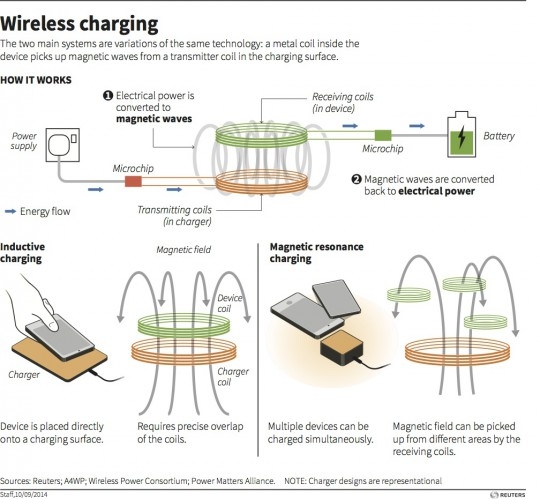
Wireless power transfer (WPT) or wireless energy transmission is the transmission of electrical energy from a power source to a consuming device, without the use of discrete man-made conductors. WPT use wireless transmitter that uses any of time-varying electric, magnetic, or electromagnetic fields to convey energy to one or wore receivers, where it is converted back to an electrical current and then used. Wireless transmission of power has numerous advantages. For example, it makes fault-prone plug contacts redundant. Devices can be built into housings that are protected against moisture ingress. Users also don’t have to go to the trouble of plugging in cables. The conventional power transmission using transmission lines to carry power from one place to another is costlier in terms of cable costs with a huge transmission loss.
Currently, wireless power transmission is mostly used in the Consumer Electronics segment, which includes electric toothbrushes, smart phones, laptops, tablets, and wireless powering of radiofrequency identification (RFID) tags. Wireless charging is fast becoming standard on smartphones. Smartphones is the largest receiver application for wireless power transmission technology owing to the adoption of inductive wireless power transmission in various smartphones in the past years. Samsung Galaxy Series, Motorola Droid phones, and Google Nexus phones are some notable smartphones, which have wireless charging capabilities. Samsung Electronics Co., Ltd. (South Korea) has a major product portfolio of smartphones integrated with wireless charging receiver capabilities.
Samsung unveiled its new smartphones called S10 and S10plus, in March 2019. A major feature of both these smartphones is reverse wireless charging. Samsung has named the feature Wireless PowerShare. It allows a person to use the back of the phone to Qi charge another phone. The reverse wireless charging was previously placed on the Huawei Mate 20 Pro phone. However, this model was available only in a few territories, excluding the U.S.A. This aided in the sales of Samsung S10 and S10pro worldwide. Dell’s new Latitude 7285 laptop, is the world’s first laptop that can charge wirelessly, according to company. To work, you’d need the Latitude 7825’s wireless charging keyboard, as well as the wireless charging mat, which are both sold separately in a combo for $550 on top of the Latitude 7825’s base $1,200 price tag.
Notably, wireless power transmission technology is being increasingly implemented in the Healthcare, Defense, and Industrial Applications segments. It is also being used to develop electric vehicles and to enable wireless charging. The rapid adoption of Electric Vehicles (EVs) globally due to low fuel consumption and performance benefits is driving the wireless charging market demand. Technical standards are maturing and consolidating, ensuring compatibility among all transmitters, portable devices, and chargers.
Researchers are developing new methods for wirelessly transmitting power throughout a room enables users to charge electronic devices as seamlessly as they now connect to WiFi hotspots, eliminating the need for electrical cords or charging cradles. Moreover, Industry 4.0 trend and the automation of production, packaging, and assembly systems in industrial settings are driving the deployment of wireless charging. The technology reduces the risk of explosions caused by stray sparks, that occur during the disconnection and connection of power cables.The future IOT sensors, actuators and devices could benefit from such technologies.
Panasonic Corp exhibited a flexible lithium-ion (Li-ion) rechargeable battery that can be attached to human body and clothes and embedded in cards at Ceatec Japan 2017, which took place from Oct 3 to 6, 2017. The flexible battery was first announced in September 2016. But, this time, Panasonic reduced its thickness by 0.1mm and demonstrated wireless charging of the battery.