

A supercomputer is a computer with a high level of computing performance compared to a general-purpose computer. Performance of a supercomputer is measured in floating-point operations per second (FLOPS) instead of million instructions per second (MIPS). There are supercomputers which can perform up to nearly a hundred quadrillions of FLOPS, measured in P(eta)FLOPS.
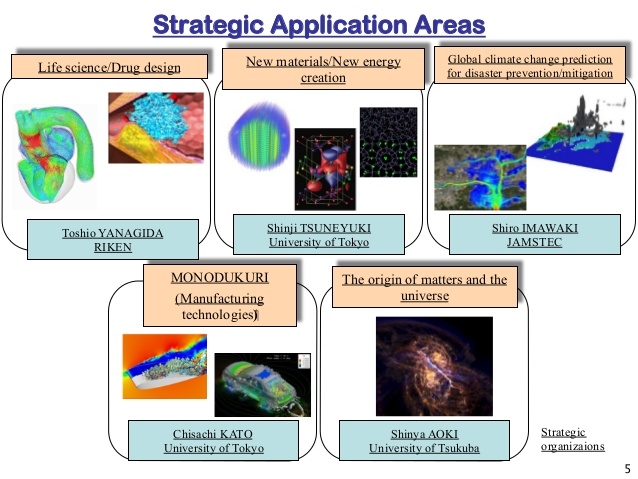
Supercomputers play an important role in the field of computational science, and are used for a wide range of computationally intensive tasks in various fields, including quantum mechanics, weather forecasting, climate research, oil and gas exploration, molecular modeling (computing the structures and properties of chemical compounds, biological macromolecules, polymers, and crystals), and physical simulations (such as simulations of the early moments of the universe, airplane and spacecraft aerodynamics, the detonation of nuclear weapons, and nuclear fusion). Throughout their history, they have been essential in the field of cryptanalysis.
China, US, and Japan are in global race of developing the fastest supercomputer. For the first time since November 2012, the US claims the most powerful supercomputer in the world, leading a significant turnover in which four of the five top systems were either new or substantially upgraded. Summit, an IBM-built supercomputer now running at the Department of Energy’s (DOE) Oak Ridge National Laboratory (ORNL), captured the number one spot with a performance of 122.3 petaflops on High Performance Linpack (HPL), the benchmark used to rank the TOP500 list. “Summit will push the boundaries of computing and human understanding,” said Ginni Rometty, Chairman, President, and CEO, IBM.
Sunway TaihuLight, a system developed by China’s National Research Center of Parallel Computer Engineering & Technology (NRCPC) and installed at the National Supercomputing Center in Wuxi, drops to number two after leading the list for the past two years. Its HPL mark of 93 petaflops has remained unchanged since it came online in June 2016.
Sierra, a new system at the DOE’s Lawrence Livermore National Laboratory took the number three spot, delivering 71.6 petaflops on HPL.
Tianhe-2A, also known as Milky Way-2A, moved down two notches into the number four spot, despite receiving a major upgrade that replaced its five-year-old Xeon Phi accelerators with custom-built Matrix-2000 coprocessors.
The new AI Bridging Cloud Infrastructure (ABCI) is the fifth-ranked system on the list, with an HPL mark of 19.9 petaflops. The Fujitsu-built supercomputer is powered by 20-core Xeon Gold processors along with NVIDIA Tesla V100 GPUs. It’s installed in Japan at the National Institute of Advanced Industrial Science and Technology (AIST).
Despite the ascendance of the US at the top of the rankings, the country now claims only 124 systems on the list, a new low. Just six months ago, the US had 145 systems. Meanwhile, China improved its representation to 206 total systems, compared to 202 on the last list.
“Supercomputers in China are driven by the government, which has made huge investments as they want to take the lead in the TOP500,” said Professor Francis Lee from NTU’s School of Computer Science and Engineering. “And they are pursuing research in areas like astronomy and seismic simulation, which require a lot of computational power.”