

Quantum key distribution (QKD) uses quantum mechanics to guarantee secure communication. It enables two parties to produce a shared random secret key known only to them, which can then be used to encrypt and decrypt messages. QKD is said to be nearly impossible to hack, since any attempted eavesdropping would change the quantum states and thus could be quickly detected by data flow monitors. This technology offers extremely high security, but its application is currently restricted to metropolitan area networks.
China has emerged as world leader in QKD networks. China has launched the world’s longest quantum-communications network, which includes a 2,000-kilometre link between Beijing and Shanghai that is meant to safely transmit sensitive information. The line is the world’s first trunk line of secure quantum telecommunications.
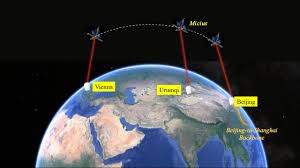
So far, the most common QKD technology uses optical fibers for transmissions over several hundred kilometers, with high stability but considerable channel loss. Another major QKD technology uses the free space between satellites and ground stations for thousand-kilometer-level transmissions. In 2016, China launched the world’s first quantum communication satellite (QUESS, or Mozi/Micius) and achieved QKD with two ground stations which are 2,600 km apart. QUESS is designed to establish ‘hack-proof’ quantum communications by transmitting uncrackable keys from space to the ground. Micious satellite has conducted several prominent experiments, including facilitating a hacking-resistant video conference between Beijing and Vienna.
The satellite will enable secure communications between Beijing and Urumqi, Xinhua said. “The newly-launched satellite marks a transition in China’s role – from a follower in classic information technology development to one of the leaders guiding future achievements,” Pan Jianwei, the project’s chief scientist, told the agency. Quantum communications holds “enormous prospects” in the field of defense, it added. Quantum communications are virtually tamper-proof. However, quantum computers will eventually be able to break current RSA encryption. China will likely transition its military telecommunications to the quantum networks, making it difficult for the United States to maintain its present level of surveillance.
In 2017, an over 2,000-km-long optical fiber network was completed for QKD between Beijing and Shanghai. The quantum communication satellite is connected to the Shanghai-Beijing line via a station in Beijing enabling the space-to-Earth quantum communication network. An almost 1,300-mile fiber link connecting Beijing, Shanghai and other cities is already up and running. Pan and his team are aiming to launch a constellation of satellites and a nationwide fiber-optic network that use qubits to securely transmit information.
Militaries have become dependent on Satellites that provide intelligence of adversary’s activities by capturing high resolution images, radar and communication signals, providing wide area real time communications among battle troops and command and control. However, Satellites are vulnerable to jamming, cyber-attacks and other ASAT weapons. China is also developing technologies like electronic warfare, DEW and other ASAT weapons that can disrupt its adversary’s satellites. By developing satellite based quantum cryptology China shall be able to gain information superiority over other countries as it would be able to collect, process, and disseminate an uninterrupted flow of information while exploiting or denying its adversary’s ability to do the same.