
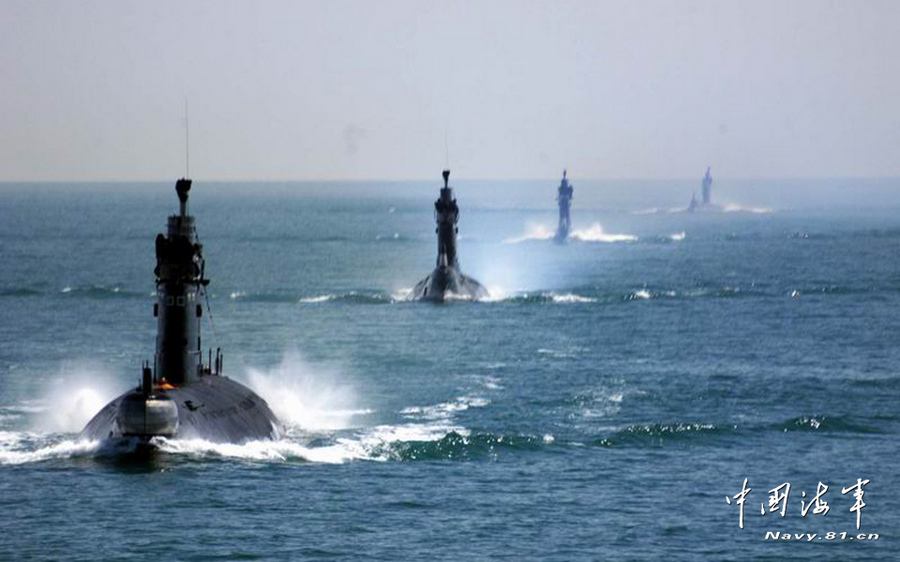

China has boosted its submarine force over the last 20 years, building a modern, flexible force that now has more total ships than the US. The force currently numbers 56 subs – four nuclear-powered missile subs, five nuclear-powered attack subs, and 47 diesel-powered attack subs – and is likely grow to between 69 and 78 subs by 2020, according to the Pentagon. Nuclear attack submarines are nuclear-powered, but they do not carry nuclear weapons, whereas nuclear strategic submarines do. Since the mid-1990s, China has built 13 Song-class diesel-electric attack subs and bought 12 Russian-made Kilo-class subs – eight of which can fire anti-ship cruise missiles.
China is building more nuclear-armed submarines to stay one step ahead of the U.S. and other adversaries. That’s the assessment from an arms control think tank, which believes China’s leaders are leaning toward basing their nuclear weapons at sea to prevent their destruction in a surprise attack. Although China will not likely built more nuclear weapons, it will likely build more submarines to conceal a larger and more effective second strike capability beneath the waves of the Pacific Ocean.
China’s newest nuclear attack sub, Type 094A, is based in an undersea submarine base at Yulin in Hainan, similar to that in Subic, complete with underground shelters. It has supreme stealth capability, just like the US Ohio-class SSBNs. The Type 094A is armed with a 12 JL-2A multiple-warhead nuclear missiles, with a range of 11,200 kilometers. JL-2, the ‘tsunami missile’, stands for the Mandarin word for ‘Big Wave’.
China’s has already deployed Type 094 Jin-class nuclear ballistic missile submarines (SSBN), that are equipped as planned with JL-2 submarine launched ballistic missiles, will for the first time enable Chinese SSBNs to target parts of the United States. The Type 094s displace about 11,000 tons submerged, capable of launching a nuclear warhead some 7,500 kilometers. China has already commissioned four JIN-class SSBNs and will build at least another one of these vessels. According to pentagon reports, China will begin fielding its next-generation SSBN, the Type 096, sometime in the coming decade, and these shall have twenty-four launch tubes armed with the JL-3 SLBM.
This also marks China’s acquisition of a viable nuclear triad for the first time. Submarines are one of deadliest weapons which are hardest to detect, literally a pile of submerged nuclear weapons ready to unleash widespread destruction with single command. In case of a nuclear war the stealthy submarines have a greater chance of surviving the first strike. Submarine-launched missiles have another benefit. They make it difficult for an enemy to predict where a missile strike may come from. This could make it harder for the enemy to intercept the missiles. Once on high alert the boats can leave their bases stay undetected for months and can carry and fire missiles that could sink even the sturdiest ship and flatten entire cities.
A new report from the Carnegie Center for Global Policy states that Beijing is seeking an unknown number of new nuclear submarines. The exact number is unknown, but the rule of thumb that a nuclear power needs four submarines to keep one on station suggests China would need to double its missile sub fleet from four to eight to see concrete improvements in the number of missiles it keeps at sea. This is because the other three submarines would need to undergo regular maintenance and crew training or would be on their way to or from patrol areas. Submarines need frequent and regular maintenance. In particular, refueling submarine reactors is a time-consuming, expensive process, which typically involves cutting the submarine open.
Since the mid-1990s, China has built 13 Song-class diesel-electric attack subs and bought 12 Russian-made Kilo-class subs – eight of which can fire anti-ship cruise missiles. Kilos are conventional diesel subs, which means they need to surface periodically. “Even with that, they’re a good, sturdy, reliable submarine that carries long-range anti-ship missiles,” said Bryan Clark, a senior fellow at the Center for Budgetary and Strategic Assessments. On a shorter operation where a Kilo-class sub “can avoid snorkeling, it could … sneak up on you with a long-range attack, so that’s a concern for the US.” China has also built 17 Yuan-class diesel-electric, air-independent-powered attack subs over the past two decades, a total expected to rise to 20 by 2020, according to the Pentagon
“China’s navy has evolved from a littoral force to one that is capable of meeting a wide range of missions, including strike missions, Jin will be able to strike Hawaii, Alaska and possibly western portions of CONUS [continental United States] from East Asian waters,” according to an assessment of the Office of Naval Intelligence (ONI). Naval modernization is part of Beijing’s “growing emphasis on the maritime domain,” the US Defense Department said in its annual report on Chinese military power.
China is building World’s largest submarine factory capable for construction of four submarines simultaneously—out of sight from military enthusiasts and spy satellites alike. According to Popular Science, Bohai Shipbuilding Heavy Industrial Corporation is building the plant in Huludao, Liaoning Province. The place will have two parallel assembly lines. The gigantic hall reportedly is where China will begin construction on is latest attack submarine, the Type 095.