

With President Xi Jinping at the helm, the Chinese government doubled down on repression inside and outside the country in 2021, says world report 2022 on human rights. Its “zero-tolerance” policy towards Covid-19 strengthened the authorities’ hand, as they imposed harsh policies in the name of public health.
Beijing’s information manipulation has become pervasive: the government censors, punishes dissent, propagates disinformation, and tightens the reins on tech giants. The once-cacophonous internet is now dominated by pro-government voices that report to the authorities on people whose views they deem insufficiently nationalistic.
Chinese President Xi Jinping is aiming to seize control over the internet to curb dissent, which could possibly threaten the Chinese Communist Party*s regime. Xi is heading towards “smart governance” which translates to having an upper hand in social and political control. Smart governance is the realm of cyberspace administration work – the increased use of artificial intelligence (AI), big data, and cloud computing, with the ultimate goal to transition China*s cyberspace from technical administration to “AI administration.”
However, Vinu Dharunesh J, an associate research fellow writing in Indo-pacific Centre for Strategic Communications (IPCSC) said that one of the largest military conglomerates in the world is seizing control of cyber security in order to eliminate threats that do not exist.
The Chinese Communist Party (CCP) is committed to the production and use of technology that controls and surveils its population, according to a congressional commission of the US. In a joint statement to Fox News, Chairman Robin Cleveland and Vice Chairman Carolyn Bartholomew of the US-China Economic and Security Review Commission said that China’s move to use technology as a tool of repression is “politically motivated to sustain the Party”. “The Chinese Communist Party is committed to the production and use of technology that controls and surveils its population. The decision to use these tools of repression is politically motivated to sustain the Party,” the statement read.
Chinese Electronics Technology Group (CETC), a state-owned military conglomerate deployed military-style surveillance – using the Hikvision Digital Technology, and command of networks across China that includes a facial recognition system which is capable of automatically identifying people, also run ethical profiling on them and tracking almost every being in sight of the cameras. This step taken by CETC is to strengthen “national security” as they say it.
Across China, the police are buying technology that harnesses vast surveillance data to predict crime and protest before they happen. The systems and software are targeting people whose behavior or characteristics are suspicious in the eyes of an algorithm and the Chinese authorities, even if they’ve done nothing wrong.
The more than 1.4 billion people living in China are constantly watched. They are recorded by police cameras that are everywhere, on street corners and subway ceilings, in hotel lobbies and apartment buildings. Their phones are tracked, their purchases are monitored, and their online chats are censored.
The Chinese government monitored every corner of Beijing by state-of-the-art surveillance cameras. Facial recognition algorithms matched with images filed away in a secret database could see you in legal trouble for something you did near your front door. A semi-political post made in a private chat could lead to the loss of your job. According to the report in Fox News, surveillance has become a booming business in the world’s most populated country with scores of tech start-ups moving in to meet the market demand with the government’s encouragement. Several human rights activists said that the enterprise has quickly become a critical apparatus for suppression and abuses, especially on minority groups.
Beijing uses a system called the Integrated Joint Operations Platform (IJOP), which has the ability to audit entire populations. The system is developed by a state-owned military contractor China Electronics Technology Corporation, IJOP. It is said to have been copied by Chinese military theorists researching how the US military used information technology during the wars in Iraq and Afghanistan and enhanced from there. “From there, it can rapidly produce names of people classified as “suspicious” — and thus marked for possible detention — purely as a result of their travel patterns abroad, mobile applications installed and key phrases used in bulletins or private messages, sometimes as basic as asking someone else where they can pray,” the report said.
The latest generation of technology digs through the vast amounts of data collected on their daily activities to find patterns and aberrations, promising to predict crimes or protests before they happen. They target potential troublemakers in the eyes of the Chinese government — not only those with a criminal past but also vulnerable groups, including ethnic minorities, migrant workers and those with a history of mental illness.
Joseph Humire, Executive Director for the Center for a Secure Free Society (SFS), told Fox News that Xinjiang serves as the “central nervous system of surveillance” in China, which is an IJOP that prompts you to enter identifying information, such as when you grow a beard, leave your house, or your blood type, etc. “These apps try to determine your pattern of life, and if Chinese authorities determine any change in your pattern of life, they come to visit you,” he told Fox News. “It is targeting the whole population with the focus on anyone who has independent thinking,” said Xiaoxu “Sean” Lin, a microbiologist and activist/spokesperson for the Washington-based Falun Dafa Association.
It is carrying out high-tech surveillance through Police checkpoints. Facial, iris and license plate recognition. Geofenced travel restrictions. Biometric registration. GPS tagging. Blanket video surveillance. And mandatory communications monitoring. China is reportedly employing a sophisticated facial recognition system that could closely monitor targeted people in a Muslim-dominant province. The network is installed at residents’ homes and workplaces in the Xinjiang Autonomous Region in western China, reported Bloomberg. The new face-reading AI technology would alert the authorities if any suspects leave more than 300 meters (984 feet) beyond the designated ‘safe areas’, said the Bloomberg report quoting an anonymous insider. “Many technologies are involved in facial recognition including Facial Action Unit analysis, facial expression recognition, deep neuro network analysis, facial muscle movement recognition, topographic modelling, deep machine learning and supercomputer technologies,” Xiaoxu added.
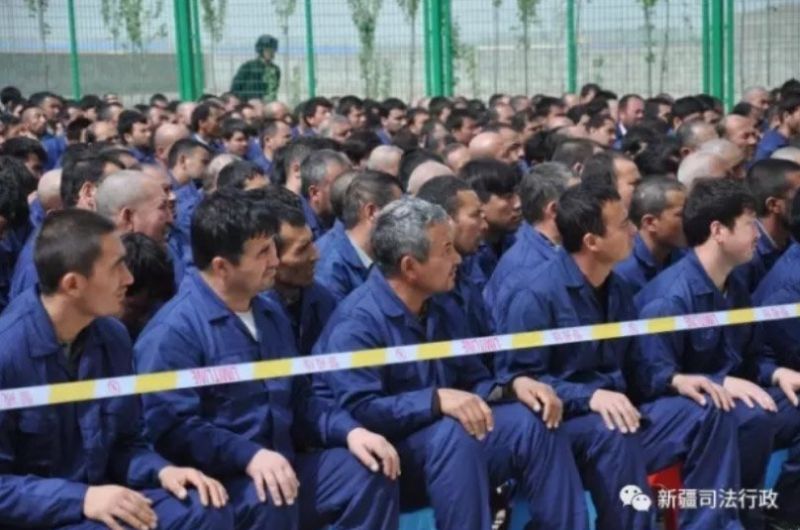
Chinese authorities claimed in March 2019 that authorities in China’s Xinjiang Uyghur Autonomous Region have arrested 13,000 ‘terrorists’ in the province in the last five years, with more than twice that number punished for so-called ‘illegal religious activities’. The detail came in a white paper entitled ‘the Fight against Terrorism and Extremism and Human Rights Protection in Xinjiang,’ issued by the State Council Information Office. Investigations of satellite footage by Bellingcat and the Guardian found that at least 31 mosques and two major shrines “suffered significant structural damage between 2016 and 2018.” Upwards of 1.5 million people forced into re-education camps. Speaking at a conference on the Uyghur crisis in DC in June 2019, student researcher Shawn Zhang said he has identified 98 camps on satellite imagery.
Chinese authorities have collected DNA and other biometric data from the whole population of the Muslim-majority western region of Xinjiang, Human Rights Watch said, denouncing the campaign as a gross violation of international norms. Chinese authorities had earlier ordered all motor vehicles in Bayingol prefecture in far-western Xinjiang to be installed with mandatory satellite tracking devices, the latest tough anti-terror measure targeting the ethnically divided region. “Cars are the main transportation means for terrorists, and are also a frequently chosen tool to carry out terrorist attacks,” the Bayingol traffic police said in a post on its official Weibo microblog account.
The International Consortium of Investigative Journalists (ICIJ) published leaked documents detailing China’s coordinated crackdown on the Uighur Muslim minority. One document described how authorities identified 40,557 people who are alleged to have shared banned content via the file-sharing app named Zapya. Zapya encourages users to download the Quran and share religious teachings, the ICIJ reported. China sees Uighurs’ religion as a threat. Zapya allows smartphones to connect to one another without being connected to the web, making it popular in areas with poor internet connection, according to the ICIJ.
The document ordered officials to investigate all 40,557 people “one by one,” and send them to “concentrated training” unless they could prove themselves innocent. It’s not clear how officials accessed the app’s user data. But the Chinese government has the power to demand user data and the contents of private conversations whenever it wants.
According to the Communist Party document, authorities found that more than 1.8 million Uighurs in Xinjiang had downloaded the software between July 2016 and June 2017, and that 40,557 of them are what it called “harmful” people. “Harmful” people include fugitives, criminal detainees, and “unauthorized imams.” The Communist Party tightly controls religion, only allowing people to practise and congregate if their sect is officially sanctioned by the government. China also makes tourists visiting the region install invasive software that downloads their texts and scans their phones for Islam-related content, a joint report by Vice, the Guardian, The New York Times, and German outlets NDR and Süddeutsche Zeitung found earlier in 2019.
Officials in Xinjiang also use a special app to log residents’ personal information, which include political views, use of birth control, and use of electricity at home, as reported by Human Rights Watch this year and detailed in ICIJ’s leaked files. Party officials policing the region also stick QR codes in front of people’s front doors to log personal information about the household and track their whereabouts. What’s new is the breadth of the repression and how the Chinese government is using breakthroughs in technology to increase its effectiveness,” Kelley Currie, a U.S. diplomat.
China’s legislature had passed its first-ever anti-terrorism laws in an effort to address what officials say is a growing threat across the country. It makes it legal for the People’s Liberation Army to take part in counter-terrorism missions abroad, and new measures to create a new counterterrorism agency, provide sweeping powers to security forces including accessing encrypted user accounts. International terrorism has emerged in recent years as a direct threat to Chinese nationals living overseas. As China’s footprint becomes increasingly global its exposure to the risk of terror attacks has increased too.
The International Campaign for Tibet (ICT) and FIDH highlight the serious human rights risks and counter-productive nature of China’s new counter-terrorism law in a new report launched at the Foreign Correspondents Club of Tokyo, Japan. ICT’s EU Policy Director Vincent Metten said: “The sweeping measures introduced in the new law – which have alarmed governments globally – are focused less on preventing terror and protecting China’s citizens, and more on the elimination of dissent and enforcement of compliance to Communist Party policies.