

Bitcoin and other virtual currencies are made possible by what’s known as blockchain technology. Blockchain technology is a digital ledger that consists of distributed, decentralized and often-times public data capable of automatically recording and verifying a high volume of digital transactions, regardless of location.
A blockchain is a type of database. Unlike a database that structures its data into tables, a blockchain, like its name implies, structures its data into chunks (blocks) that are chained together. Blocks have certain storage capacities and, when filled, are chained onto the previously filled block, forming a chain of data known as the “blockchain.” The chain grows continuously as miners discover new blocks that they append to the existing Blockchain. Miners would compete with each other to create such blocks. Once a winning block is appended to the Blockchain, a new copy of the block is broadcasted to the entire network, thus, creating a decentralized public ledger.
For Bitcoin, this blockchain is just a specific type of database that stores every Bitcoin transaction ever made. Bitcoin consists of thousands of computers, but each computer or group of computers that hold its blockchain is in a different geographic location and they are all operated by separate individuals or groups of people. These computers that make up Bitcoin’s network are called nodes. This system also inherently makes an irreversible timeline of data when implemented in a decentralized nature. Each block in the chain is given an exact timestamp when it is added to the chain.
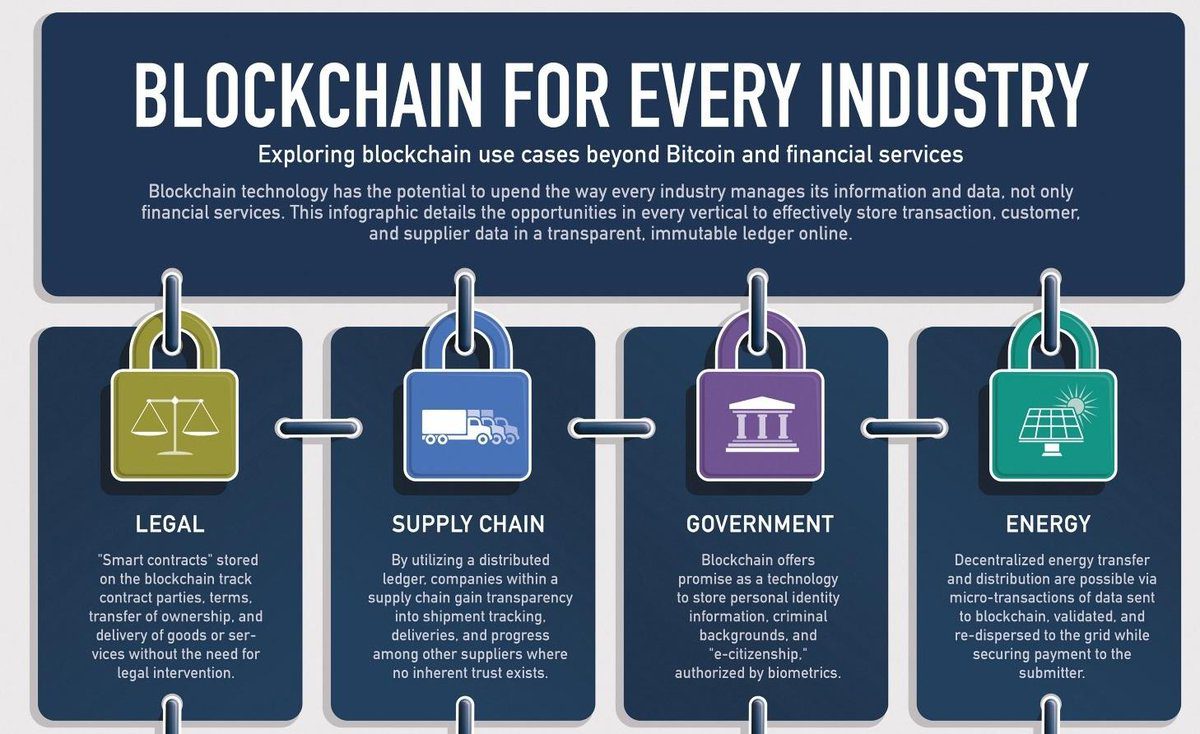
Blockchain is, by nature, a distributed ledger since each node has a full record of the data that has been stored on the blockchain since its inception. For Bitcoin, the data is the entire history of all Bitcoin transactions. If one user tampers with Bitcoin’s record of transactions, all other nodes would cross-reference each other and easily pinpoint the node with the incorrect information. This system helps to establish an exact and transparent order of events. For Bitcoin, this information is a list of transactions, but it also is possible for a blockchain to hold a variety of information like legal contracts, state identifications, or a company’s product inventory.
Blockchain technology now touches virtually every sector — from safeguarding medical records and patient privacy, to tracking food safety and drug supply chain compliance, to verifying artwork authenticity, to validating oil and gas transactions and even land ownership globally. Organizations are now using blockchain to secure their data, reduce inefficiencies in the supply chain and logistics network, and in intellectual property management.
Blockchain is also predicted to enable Industry 4.0. This new form of manufacturing, called Industry 4.0 is a collection of technologies and concepts for defining and operating ‘Smart Factories’, where the machinery of manufacturing – machine tools, the sensors monitoring them and such like – can communicate with each other, with the systems overseeing the factory and the people who work in it to fine-tune the manufacturing process and enable such things as product customization, while increasing productivity and flexibility. These intelligent and connected machines don’t only work; they take decisions and optimize processes intelligently and semi-autonomously.
In order to build trustworthy and effective government operations through collaborative and transparent networks, different government organizations and units can use Blockchain technology. Blockchain technology with its salient features will help provide accountability, transparency and trust among stake holders such as citizens, leaders, government officials, and their different operations. Further, blockchain is being used by governments for digital identity management. A good example is Estonia, which is using blockchain-based for digital identity to digitize national identity records, secure citizen data to reduce identity fraud, and reduce inefficiencies of legacy digital ID management platforms such as high costs.
The deputy director of China’s Ministry of Industry and Information Technology (MIIT), Xin Guobin said, “[Blockchain] can make up for the deficienc[ies] of traditional credit system, prevent information tampering and forgery, and save [money for] society. [This would apply to] finance, e-commerce, smart medical care, social security, Internet of Things, energy and other fields, and will have an important impact.”
Blockchain has numerous current limitations before broad adoption and implementation. Scalability, regulatory challenges, security risks,
and energy consumption are major limitations. The rise of permissioned or private Blockchains for industrial applications also has critics. Permissioned blockchain is very different from public blockchain; its emergence has hidden blockchain platforms’ advantages. Blockchain undergoes several scalability issues such as communication malfunctions among users, data storage, and linear transaction record.