
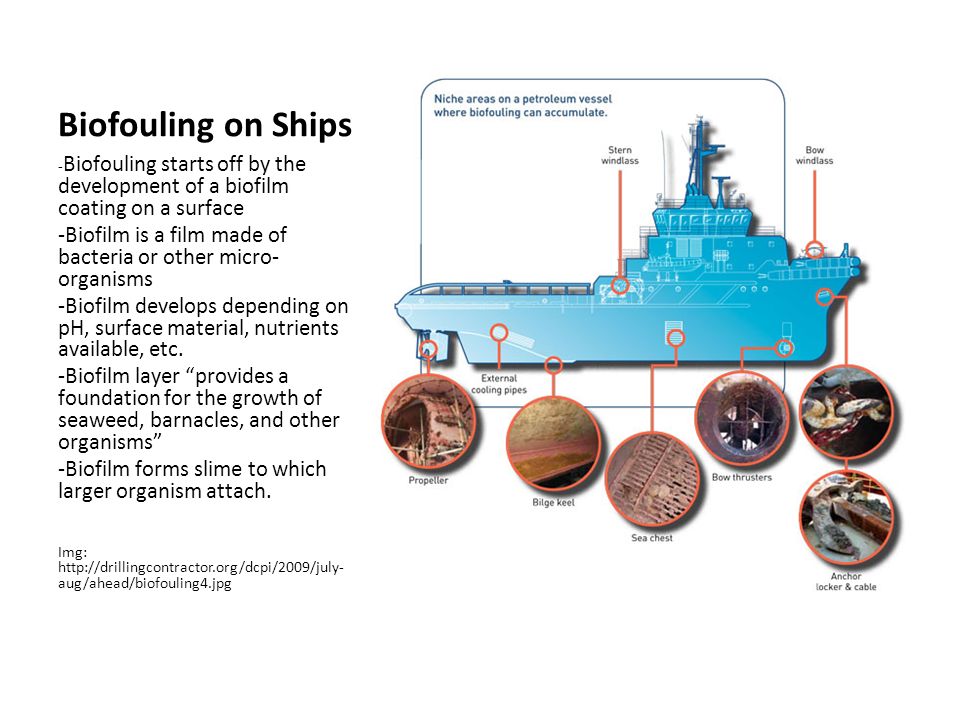

Biofouling is one of the main problems faced by every type of ship at the sea. Marine growth such as barnacles and mussels have been the reason for problems such as decreased ship efficiency, corrosion etc. Biofouling not only sticks to the external surface of the ships but also gets into the water intakes and sticks to the surface of the pipes leading to problems such as blockage and corrosion.
In March 2017, the bulk carrier DL Marigold became the world’s first biofouling “casualty.” The vessel was ordered from both New Zealand and Fijian waters for being an invasive species threat, after divers discovered dense fouling of barnacles and tube worms on the ship’s hull. It was the first time an international ship had been ordered to leave a New Zealand port because of biofouling.
Bacteria especially Pseudomonas aeruginosa, that is found throughout the world’s oceans can cause ships to lose up to 40 millimetres per year even when built with duplex stainless steel, one of the hardest and most corrosion resistant materials used in the industry.
Though mechanical removing tools can be used to get rid of such marine growth, this is not always possible. For this reason, different types of marine growth prevent systems are used on board ships, along with anti-fouling paints. Advanced coating materials are used to prevent bio-fouling and corrosion, however “Most protective coatings need to be re-applied every few years.
Biofouling costs the aquaculture and shipping industries billions of dollars a year in maintenance and extra fuel usage. Scientists from the University of Sydney have developed nanowrinkled coatings that have the potential to avoid the build-up of damaging biological material and save up to $320 million annually spent by the Australian shipping industry because of biofouling.
The weight and drag caused by bacteria living on the surface of ships can also affect speed and maneuverability, the researchers said. They estimated that more than a third of fuel consumed by Chinese ships was wasted compensating for extra drag caused by bio-corrosion. US spends upwards of US$23 billion on the issue every year
Chinese scientists have developed a new material by combining copper with the widely used duplex stainless steel in the right formulation, which is corrosion and bacterial resistant while as strong as the steel.The new material could be a breakthrough in helping China become a new sea power, said Huang Weiping, a marine engineering professor with the Ocean University of China who was not involved in the research.