
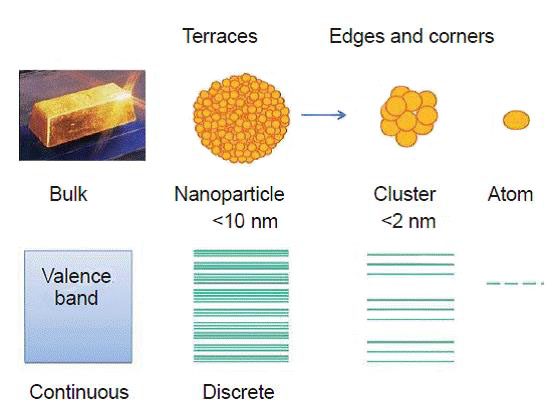

Atomic clusters, consisting of a few to a few thousand atoms, have emerged over the past 40 years as the ultimate nanoparticles, whose structure and properties can be controlled one atom at a time. More importantly, the possibility of creating a new class of materials, composed of clusters instead of atoms as building blocks, has fueled the hope that one can synthesize materials from the bottom-up with unique and tailored properties.
Clusters comprising up to few tens of atoms are an intermediate state of matter. Unlike molecules and crystalline particles, clusters do not have a regular structure. A cluster of a given size may have many different isomers, some of which may be close in energy.
The most exciting thing is that the atomic clusters of sub-nano or nano-scale are often show drastic change in the physical and chemical properties compared to that of their bulk material, due to the effect of quantum confinement. This different behavior of nano-scale materials is found to be very useful in various kinds of applications to the mankind for the last two decades.
Clusters offer exciting prospects for designing new materials, owing to the strong dependence of their electronic properties on their size and structure. The cluster assembled materials are solids where atomic clusters serve as the fundamental units. The exciting thing for these solids is that they takes the advantage of the exotic properties of clusters due to the effect of quantum confinement and make them accessible in a bulk material with a tunable chemical, electronic, optical and magnetic properties. The cluster assembled materials are formed with a network by linking the cluster motifs as building blocks with an atomic/molecular linker. Some of the special clusters of stable motif classified with aromatic, jellium and Zintl models possess potency to be used as building blocks in the cluster assembled materials.
Clusters are considered as promising catalysts because they exhibit a higher reactivity than bulk materials. Even noble metals such as gold and platinum become highly reactive as clusters. Clusters may also serve as models to elucidate the structure and function of catalytically active sites on surfaces.