
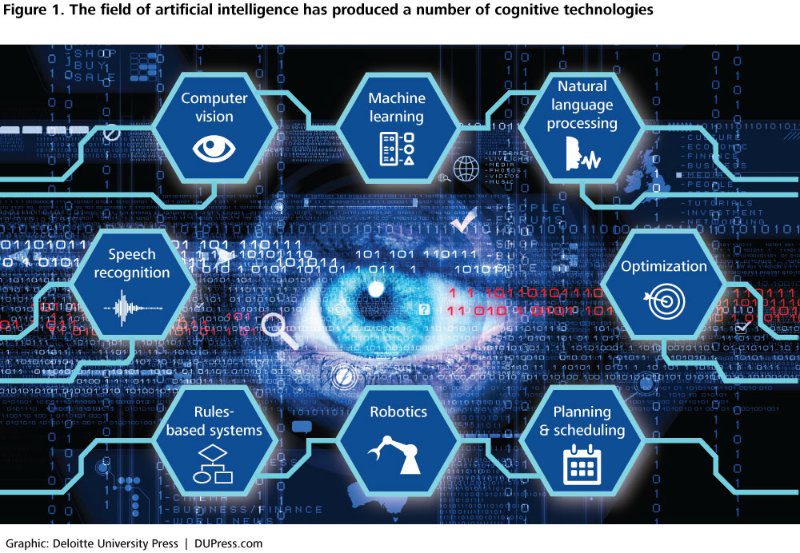

Artificial intelligence (AI) term was coined by John McCarthy, defined it as “the science and engineering of making intelligent machines”. The field was founded on the claim that a central property of humans, intelligence can be so precisely described that a machine can be made to simulate it. The general problem of simulating (or creating) intelligence has been broken down into a number of specific sub-problems. These consist of particular traits or capabilities that researchers would like an intelligent system to display. These include reasoning, knowledge, planning, learning, natural language processing (communication), perception and the ability to move and manipulate objects.
AI is further divided into two categories: narrow AI and general AI. Narrow AI systems can perform only the specific task that they were trained to perform, while general AI systems would be capable of performing a broad range of tasks, including those for which they were not specifically trained. General AI systems do not yet exist.
Remarkable progress has been made on what is known as Narrow AI, which addresses specific application areas such as playing strategic games, language translation, self-driving vehicles, and image recognition. Narrow AI underpins many commercial services such as trip planning, shopper recommendation systems, and ad targeting, and is finding important applications in medical diagnosis, education, and scientific research. These have all had significant societal benefits and have contributed to the economic vitality of the Nation.”
General AI (sometimes called Artificial General Intelligence or AGI) refers to a notional future AI system that exhibits apparently intelligent behavior at least as advanced as a person across the full range of cognitive tasks. Attempts to reach General AI by expanding Narrow AI solutions have made little headway over many decades of research. The current consensus of the private-sector expert community, with which the NSTC Committee on Technology concurs, is that General AI will not be achieved for at least decades.
Machine Learning (ML) [a subfield of AI] has now become a pervasive technology, underlying many modern applications including internet search, fraud detection, gaming, face detection, image tagging, brain mapping, check processing and computer server health-monitoring. There is a wide variety of algorithms and processes for implementing ML systems.
AI has gotten more accurate and much faster at image detection. It’s also improved at parsing the grammatical structure of sentences, answering multiple-choice questions and translation. Today, AI forms the basis of computer systems handling tasks such as voice recognition and translation on smartphones, piloting driverless cars, and controlling robots that automate chores in homes and factories.
Artificial intelligence (AI) is widely accepted as having the potential to create significant economic value. In research, AI is being used in a growing number of applications, such as processing the enormous amounts of data that underpin fields including astronomy and genomics, producing climate models and weather forecasts, and identifying signs of disease in medical imaging.
On the official website of The White House, the report, dubbed “Preparing for the future of Artificial Intelligence,” authors state that Artificial Intelligence (AI) has the potential to help address some of the biggest challenges that society faces.” Smart vehicles may save hundreds of thousands of lives every year worldwide, and increase mobility for the elderly and those with disabilities. Smart buildings may save energy and reduce carbon emissions. Precision medicine may extend life and increase quality of life. Smarter government may serve citizens more quickly and precisely, better protect those at risk, and save money. AI-enhanced education may help teachers give every child an education that opens doors to a secure and fulfilling life. “New artificial intelligence applications will have an impact in various fields, including manufacturing, business, stock market analysis, economic inclusion, criminal justice, environment, transportation, health care and space exploration. Accenture analyzed 12 developed economies and found that AI has the potential to double their annual economic growth rates by 2035.
Revenues have also skyrocketed. The International Data Corporation (IDC), a market research company based in Framingham, Massachusetts, predicts that worldwide revenues for the AI market will total $156.5 billion in 2020, an increase of 12.3% over 2019. Although growth in 2020 is slower than in previous years due to the economic impact of the COVID-19 pandemic, the IDC expects that global revenues will surpass $300 billion in 2024.