

Space capabilities have become central to many military operations, including missile warning, geolocation and navigation, target identification, and tracking of adversary activities. US, Russia and China are world leaders in militarization of space possessing extensive space infrastructure. The NASIC report said there number of foreign intelligence and imaging satellites “has tripled” to 300 in orbit in the last two decades. The U.S. itself has 353 of its own space assets in orbit for those purposes.
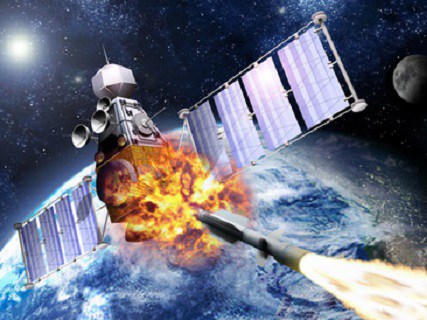
The growing dependence of militaries on space has made space a strategic target denying all the advantages of space to the adversaries during conflict. In response, military superpowers have poured funding into researching and developing anti-satellite weapons. In response other countries have also been driven to develop them as deterrent.
Chinese and Russian military doctrines indicate that they view space as important to modern warfare and view counterspace capabilities as a means to reduce U.S. and allied military effectiveness. China and Russia are developing anti-satellite (ASAT) missiles that could shoot US low Earth orbit (LEO) objects and will be combat-capable as early as 2020, according to US Intelligence reports. It was already established by the US military that those two countries are developing satellites that are able to maneuver through space, potentially enabling them to smash into US satellites. Russia was seeking a “diverse suite of capabilities to affect satellites in all orbital regimes,” such as a laser gun.
Both reorganized their militaries in 2015, emphasizing the importance of space operations, according to the Defense Intelligence Agency (DIA) released report Feb 2019, “Challenges to Security in Space,” that examines the space and counterspace programs that could challenge U.S. or partner interests in the space domain. Both have developed robust and capable space services, including space-based intelligence, surveillance, and reconnaissance. Moreover, they are making improvements to existing systems, including space launch vehicles and satellite navigation constellations. These capabilities provide their militaries with the ability to command and control their forces worldwide and also with enhanced situational awareness, enabling them to monitor, track, and target U.S. and allied forces. Chinese and Russian space surveillance networks are capable of searching, tracking, and characterizing satellites in all earth orbits. This capability supports both space operations and counterspace systems. Both states are developing jamming and cyberspace capabilities, directed energy weapons, on-orbit capabilities, and ground-based antisatellite missiles that can achieve a range of reversible to nonreversible effects.
On April 2020, Russia conducted a test of its direct-ascent anti-satellite (DA-ASAT) missile system, which is designed to destroy satellites in low Earth orbit. This test followed the country’s on-orbit test maneuvers of two satellites that “exhibited characteristics of a space weapon,” COSMOS 2542 and COSMOS 2543, which the U.S. has been closely following, the U.S. Space Force said in a statement. In February, the U.S. Space Force spotted these Russian satellites following a U.S. spy satellite, behavior that Space Force commander Gen. John “Jay” Raymond described at the time as “unusual and disturbing.”
In July 2020, The US and Britain accused Russia of carrying out an anti-satellite weapons test in space, firing a projectile from a Russian satellite that could be used to take down other satellites in orbit. “We are concerned by the manner in which Russia tested one of its satellites by launching a projectile with the characteristics of a weapon,” said Air Vice Marshal Harvey Smyth, head of the UK’s Space Directorate, in a statement late Thursday. “Actions of this kind threaten the peaceful use of space and risk causing debris that could pose a threat to satellites and the space systems on which the world depends. We call on Russia to avoid any further such testing,” he said. Russia’s Defense Ministry said of the July 15 test that “During testing of the latest space technology, one of the domestic satellites was examined close up using the specialized equipment of small space craft,” adding that “valuable information about the technical condition of the object under investigation” had been obtained.
US Space Command said that on July 15, a Russia satellite called Cosmos 2453 “operated in abnormally close proximity to a US government satellite in low-earth orbit before it maneuvered away and over to another Russian satellite, where it released another object in proximity to the Russia target satellite.” This test is inconsistent with the intended purpose of the satellite as an inspector system, as described by Russia.” “This is further evidence of Russia’s continuing efforts to develop and test space-based systems, and consistent with the Kremlin’s published military doctrine to employ weapons that hold US and allied space assets at risk,” he added.
The U.S. Space Force also has serious concerns about this recent DA-ASAT missile test. “Russia’s DA-ASAT test provides yet another example that the threats to U.S. and allied space systems are real, serious and growing,” Raymond said in yesterday’s statement. “The United States is ready and committed to deterring aggression and defending the nation, our allies and U.S. interests from hostile acts in space.”The Director of National Intelligence’s annual report to Congress stated that the PRC and Russia have operational ASATs for targeting low Earth orbiting satellites, and the PRC is “probably” developing capabilities for geostationary orbit
Compared to both Russia and China, US Military is more dependent on space assets, hence more vulnerable to ASAT weapons which are regarded as important asymmetric warfare weapons. “We assess that, if a future conflict were to occur involving Russia or China, either country would justify attacks against U.S. and allied satellites as necessary to offset any perceived U.S. military advantage derived from military, civil or commercial space systems,” warns the 2018 Worldwide Threat Assessment of the U.S. Intelligence Community, released by the Office of the Director of National Intelligence.
The US, of course, has its own military capabilities in space. It tested an anti-satellite missile in 2008, and regularly operates the X-37B spacecraft, a miniature space shuttle that can also maneuver in space and whose purpose is the subject of much speculation. Congress added more than $32 million to the Air Force’s space budget in fiscal 2015 to study future antisatellite capabilities, including offensive and “active defense” capabilities. It also instructed DOD to “conduct a study of potential alternative defense and deterrent strategies in response to the existing and projected counterspace capabilities of China and Russia.”
The Boeing X-37B unmanned space plane may also figure in U.S. anti-satellite warfare. OTV-5, a 780-day-long X-37B mission, is reported to have released three small cubesats into orbit. These cubesats, Breaking Defense suggests, could be part of an anti-satellite warfare research program. US Defense officials have asked for $304 million to fund research into space-based lasers, particle beams, and other new forms of missile defense. Pentagon is undertaking two studies. The first is a $15 million exploration of whether satellites outfitted with lasers might be able to disable enemy missiles coming off the launch pad. Defense officials have said previously that these lasers would need to be in the megawatt class. They’re also studing of space-based neutral particle beams, a different form of directed energy that disrupts missiles with streams of subatomic particles traveling close to light speed — as opposed to lasers, whose photons travel at light speed.
All three countries are also advancing space robotics and launching “experimental” satellites for on-orbit satellite inspection, refueling and repair that can also be used against adversary spacecraft. There has also been unusual behavior from China’s SJ-17 inspector satellite in geostationary orbit that has raised eyebrows, Kaitlyn Johnson, associate director of the Aerospace Security Project said. “This is a great example … of a dual-use system,” she noted. The satellite could be used for on-orbit servicing missions such as testing ways to refuel a satellite on orbit, or used for counterspace attacks, she said. “This is a great place to have on-orbit servicing and we see the United States doing the same thing,” she said. “But it also is the same technology you would need to carry out a co-orbital counterspace attack.”
Indian Prime Minister Narendra Modi declared in March 27, 2019 that the country had pulled off an ASAT missile launch that same day. The launch, “Mission Shakti,” likely struck an Indian satellite in low Earth orbit, turning the object into debris. The satellite used in the mission was one of India’s existing satellites operating in lower orbit. The significance of the test is that India has tested and successfully demonstrated its capability to interdict and intercept a satellite in outer space based on complete indigenous technology.
Japan is considering building anti-satellite weapons but also uses the same radar and missile system involved in Operation Burnt Frost, giving it a latent ASAT capability. France is working to develop laser dazzlers to blind satellites.
Countries such as North Korea and Iran have active space programs but progress is slow and both are a long way from fielding operational weapons. Iran has placed its focus on space launch vehicles and has had four launch attempts from 2019 to 2020, all of which ended in failure, said Makena Young, a research associate with the Aerospace Security Project and co-author of the report. Similar to Iran, North Korea has a long history of counterspace activities. However, this year the county has largely been focused on rebuilding its Sohae satellite launching facility. “In late 2019, North Korea conducted two engine tests at this site, believed to be modified liquid-fuel engines for long-range missiles, she said. “Although it was conducted at the satellite launching pad, experts assessed that it was likely another missile test or a step towards [intercontinental ballistic missile] development.”