

Navies around the world are increasingly facing formidable strategic and threat environments in terms of complexity, lethality, range, sophistication and number of threats. Many of these threats, including long-range anti-ship cruise missiles, can travel hundreds of miles to their targets, toward surface ships challenged to detect the approaching weapon with line-of-sight radar systems. To counter these threats, the militaries around the world are developing networked integrated Air and Missile defense systems (IAMD). IAMD entails both the defence against conventional air threats, such as aircraft, helicopters, unmanned aerial vehicles and balloons (air defence), as well as the defence against ballistic missiles and cruise missiles (missile defense).
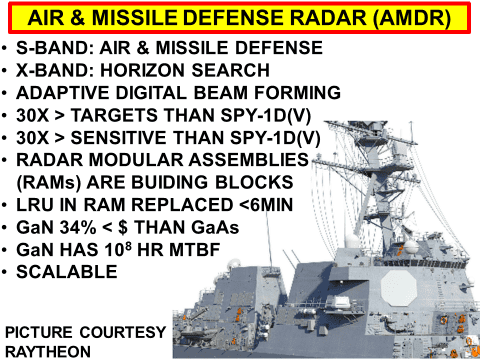
The essential requirement of IAMD is a radar which can simultaneously detect and track air and missile targets. Raytheon’s AN/SPY-6(V) radar is capable to simultaneously protect a warship from cruise missile, ballistic missile, hostile aircraft and surface ship attacks. The AN/SPY-6(V)1 Air and Missile Defense Radar (AMDR) is the Navy’s next-generation radar providing sensitivity for long-range detection and engagement of advanced threats. The AN/SPY-6 radar, provides greater range, enhanced accuracy and improved resistance to environmental and man-made electronic clutter, higher reliability and sustainability than currently deployed radars.
The Raytheon-built AN/SPY-6(V) radar is reported by developers to be 35-times more powerful than existing ship-based radar systems; the technology is widely regarded as being able to detect objects twice as far away at one-half the size of current tracking radar. This synergy gives the system an ability to track and help destroy enemy drones, aircraft, cruise missiles and long-range incoming ballistic missiles.
The new radars are in the process of being built into large portions of the fleet to include emerging new DDG Flight III destroyers, amphibious assault ships and even aircraft carriers. Since its launch in January 2014, the US Navy’s SPY-6(V) programme has successfully met all milestones either ahead of or on schedule.
The AN/SPY-6(V)1 is currently planned to be deployed on the DDG 51 FLT III with four arrays each populated with 37 Radar Modular Assemblies (RMAs) providing SPY+16dB sensitivity. A variant of the AN/SPY-6(V) is currently planned to replace the AN/SPY-1 radar on existing DDG 51 FLT IIA ships. This variant includes four arrays each populated with 24 RMAs providing SPY+11dB sensitivity. The U.S. Navy is proceeding with the modernization of DDG 51 FLT IIA ships by replacing the existing AN/SPY-1D(V) with a scaled AN/SPY-6(V) radar to increase IAMD performance against raids of air and ballistic missile threats in adverse environments.
US Navy’s AN/SPY-6(V) Air and Missile Defense Radar (AMDR) program is a new scalable solid-state radar suite intended for future surface combatants such as the CG(X) missile cruiser and DDG 51 Flight III destroyer. The AN/SPY-6 platform will enable next-generation Flight III DDG 51s to defend much larger areas compared with the AN/SPY-1D radar on existing destroyers.
Raytheon Missiles & Defense (RMD) secured a contract to continue the production of AN/SPY-6(V) air and missile defence radars for the US Navy, reported in May 2022. The contract has an estimated value of $423m. The radars produced under the contract will be equipped on seven different types of US Navy ships, including amphibious ships, the Arleigh Burke-class Flight III destroyers and aircraft carriers. The company has already completed the installation of SPY-6 radar on the US Navy’s future USS Jack H Lucas (DDG 125), a Flight III destroyer.
Demonstrations
Raytheon’s AN/SPY-6(V) air and missile defence radar (AMDR) has successfully detected, acquired and tracked multiple targets during demonstrations at the US Navy’s Pacific Missile Range Facility, Kauai, Hawaii. During the exercise, the radar system exhibited its ability to track multiple threats simultaneously, as well as a ballistic missile, through intercept.
In February 2019 , the Spy-6 air and missile defense radar system successfully completed its most challenging test. It searched for, detected and maintained track of a short-range ballistic missile target launched from the Pacific Missile Range Facility in Kauai, Hawaii. Test success proved AN/SPY-6(V) integrated air and missile defense performance against a short-range ballistic missile target and multiple anti-ship cruise missile targets. The test demonstrated the radar’s sensitivity and resource management, a critical multi-mission capability to extend the battlespace and safeguard the fleet from multiple threats.
“This radar was specifically designed to handle ballistic missiles and cruise missiles simultaneously and it’s doing just that,” said U.S. Navy Captain Seiko Okano, Major Program Manager for Above Water Sensors, Program Executive Office Integrated Warfare Systems.”The speed, range, trajectory and complexity of multiple targets proved no match for AN/SPY-6 – it acquired and tracked them all,” said Raytheon’s Tad Dickenson, AN/SPY-6(V) program director. “AMDR is successfully demonstrating performance in a series of increasingly difficult test events and is on track to deliver advanced capability to the Navy’s first Flight III Destroyer.”
Two variants of the SPY-6 radars completed a series of tests at the Navy’s Wallops Island test facility in Virginia, which prime contractor Raytheon says was necessary to keep the program’s development on track. The testing, which occurred earlier in 2021, was focused on demonstrating new functionalities for both variants and will allow testing to advance to multi-functional operations and combat management system integration.
The AN/SPY-6 is expected to undergo further development and testing, with plans to eventually integrate it as the next-generation radar for Aegis ballistic missile defense (BMD) on U.S. Navy guided missile destroyers. The radar will work with the Standard Missile-3 (SM-3) Block IA/IB and Block IIA when deployed as well as the Standard Missile-6 (SM-6).
In total, the Navy plans as many as 22 Flight III DDG 51 destroyers, according to a previously completed Navy capabilities development document. The SPY-6 AMDR scalable radar system is expected to become the tip of the spear of the US Navy’s anti-missile and anti-aircraft capabilities for the next 40 years, through 2050 and beyond.