
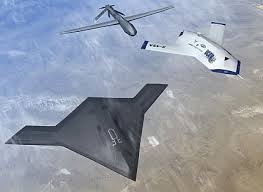

The current Armed drones like Predators and Reapers are essentially remote controlled that is they involve human operators remotely controlling the vehicle with the assistance of fairly low levels of automation for some functions (e.g., the operator specifies waypoints to be followed by the platform). Systems like these have proved to be successful in permissive environments like Afghanistan and Iraq; However Predators and Reapers are useless in a contested environment, i.e. are at risk when confronted with advanced air defense systems. The Pentagon needs to move away from Predator and Reaper unmanned systems and establish a fleet of intelligence, surveillance and reconnaissance (ISR) aircraft that can handle contested environments, said a top Air Force general.
Anti-access and area denial (A2/AD) environment could be countered by highly autonomous systems. Autonomy is a capability (or a set of capabilities) that enables a particular action of a system to be automatic or, within programmed boundaries, “self-governing.” As described in the most recent Unmanned Systems Roadmap, there are four levels of autonomy: Human Operated, Human Delegated, Human Supervised, and Fully Autonomous. However, the Roadmap notes that in contrast to automatic systems, which simply follow a set of preprogrammed directions to achieve a predetermined goal, autonomous systems “are self-directed towards a goal in that they do not require outside control, but rather are governed by laws and strategies that direct their behavior.
Autonomy and Autonomous Platforms and Weapons
One of the advantages of employing autonomous weapons and platforms is speed. OODA loop, a four-step decisionmaking process in which an individual observes, orients, decides, and then acts. In combat, there is a premium on completing one’s own decision loop as quickly as possible while at the same time disrupting, or at least delaying, that of one’s opponent. This is known as getting “inside” an enemy’s OODA cycle. As research into AI continues to advance, computerized combat systems are likely to be able to quickly analyze a situation and then provide a recommended course of action to a military commander. If so, the human element would represent the slowest part of the decision loop, and by enhancing autonomy by eliminating direct human involvement altogether and replacing it with a system that is fully autonomous would lead to speeding up of OODA loop.
Another potential advantage offered by autonomous platforms and weapons lies in their relative immunity to Jamming and other electronic and cybersecurity attacks. Current unmanned systems, that require almost constant communication between themselves and their human operators which can be Jammed in highly contested battlefield. A sufficiently autonomous system, on the other hand, would be able to execute its mission even if data links are compromised. If introduced on a large scale, they also have the potential to greatly reduce manpower requirements and the associated costs.Unlike human beings, autonomous systems do not need to be trained, fed, housed, or paid, nor do they require medical care or retirement pay.
“Unmanned systems and autonomous software offer significant potential advantages for meeting the challenges of a newly forming adversarial environment. Speed of light cyber-attacks, anti-access/area-denial (A2SD) actions that keep our forces operating at a distance, and potential attacks on our space-based assets all require innovative solutions for maintaining mission effective air, space and cyber operations in the face of these new challenges.”
Autonomous systems provide a considerable opportunity to enhance future Air Force operations by potentially reducing unnecessary manning costs, increasing the range of operations, enhancing capabilities, providing new approaches to air power, reducing the time required for critical operations, and providing increased levels of operational reliability, persistence and resilience.
This is the view of Air Force Office of the Chief Scientist that has come with report “Autonomous Horizons Volume I: Human Autonomy Teaming”. It serves to provide direction and guidance on the opportunities and challenges for the development of autonomous systems for Air Force operations. In laying out a vision for the next 30 years, the U.S. Air Force strategy provides an emphasis on the development of system autonomy as a means of achieving strategic advantage in future operations.
This includes an increased use of automation software and more advanced algorithms that enable systems to act autonomously or “react to their environment and perform more situational-dependent tasks as well as synchronized and integrated functions with other autonomous systems”.