
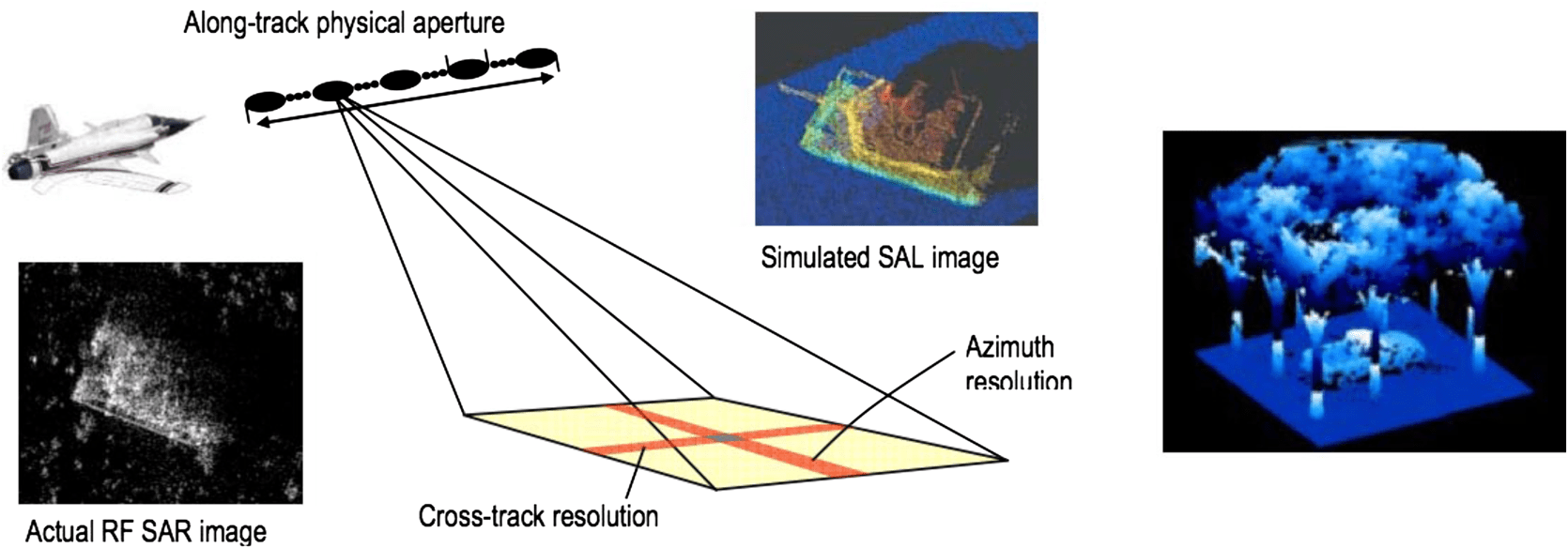

Conventional optical imagers are limited in spatial resolution by the diffraction limit of the telescope aperture, as well as by the practical difficulties in increasing the telescope aperture. Synthetic aperture (SA) techniques can increase resolution beyond the diffraction limit of the receiving aperture.
Just as synthetic aperture radar(SAR) working in radio frequency, makes use of the movement between the platform and the target plus the signal processing techniques to obtain high resolution image. SAL in the optical laser domain, can enable fine-resolution, two-dimensional, active imaging at long range with small diameter optics.
A synthetic aperture ladar (SAL) could provide dramatic improvements in either resolution or, compared to synthetic aperture radar (SAR), the time needed to record an image, or both. The reduced imaging time results from the shorter time needed by the platform to traverse the synthetic aperture (SA) that produces the same resolution with a shorter wavelength.
When the observation range reaches a thousand kilometers or more, no other method of imaging can offer centimeter-class resolution with a real aperture size no larger than a few meters. Additionally, because SAL is an active sensing method, it is not restricted to daylight operation.
The first airborne synthetic aperture ladar image data was collected at Edwards AFB, Calif., February 17, 2006, by SALTI contractor Raytheon Space and Airborne Systems using fiber lasers developed for the telecommunications industry and employing customized commercial fiber oscillators, amplifiers and detectors.
“Synthetic aperture laser radar technology satisfies the critical need for reliable, long-range battlefield awareness. An image that takes radar tens of seconds to produce can be produced in a few thousandths of a second at optical frequencies,” explained Dr. Jennifer Ricklin, DARPA program manager for SALTI. “While radar waves respond to macroscopic features such as corners, edges, and facets, laser waves interact with microscopic surface characteristics, which results in imagery that appears more familiar and is more easily interpreted.”