

Aerogels are among the lightest materials in the world and are highly porous with strong absorption capacity and low thermal conductivity which make them highly suitable for applications oil-spill cleaning, personal care products like diapers and heat, and sound insulation.
“Aerogel is what NASA uses to insulate the space shuttles, Mars rovers and other things in space,” Michael Markesbery says. “Space is negative 4550° F. This insulation is surviving the best torture test in the universe, but it isn’t being used in apparel.” Markesbery and Venna plan to disrupt the outdoor and performance apparel industry with Oros’ exclusive Solarcore insulation, the brand name for the company’s use of NASA’s aerogel material on which it has filed several patents.
The high air content (99.98% air by volume) makes it one of the world’s lightest solid material. Aerogels can be made from a variety of chemical compounds, and are a diverse class of materials with unique properties. Silica aerogels are nanomaterials with excellent thermal insulations properties because 99.98% of their volume can be pure air. They usually have low density and low thermal conductivity.
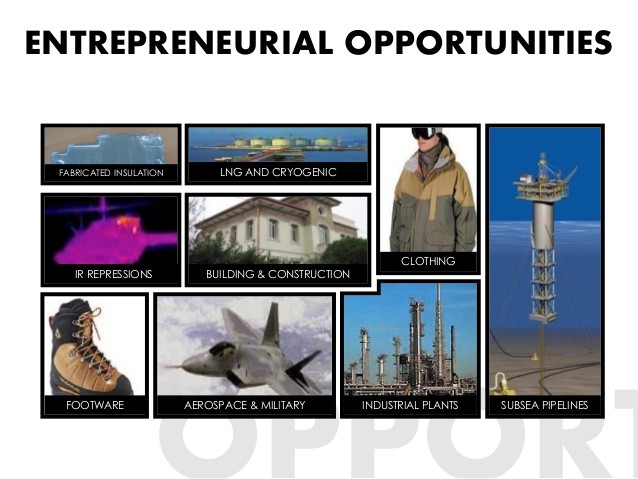
Silica aerogels could be considered as the ecofriendly “plastic” of the 21st century because they can find application in any field. Common applications include enhancing the thermal performance of energy-saving materials and sustainable products for buildings, acting as a high performance additive to coatings, prevention of corrosion under insulation, uses in imaging devices, optics, and light guides, thermal breaks and condensation control, architectural lighting panels, outdoor and sports gear and clothing.
Aerogels, when manufactured, can exhibit varying degrees of opacity, including both translucency and transparency, thereby enabling a diverse variety of applications for insulation in buildings that might require access to daylight or exploit sunlight for energy.
They may also find use as temperature-resistant windows, and in the space industry. As aerogels are phenomenal energy savers they could be the paradigmatic materials for designing the insulation for future sustainable space habitats. One of the most promising applications for aerogels is as a shock-absorbing medium in safety equipment.
Aerogel is created by combining a polymer with a solvent to form a gel, and then removing the liquid from the gel and replacing it with gas (usually air).
The greatest obstacle to the widespread use of aerogels is cost. The cost of aerogels is not inherent in their composition; silica is one of the most common minerals on Earth. The cost results from the time and energy it takes to produce them. Aerogel production involves two main steps: the preparation of a wet silica gel, and the removal of the wet matrix by supercritical fluid drying, a process requiring high temperatures and pressures.