
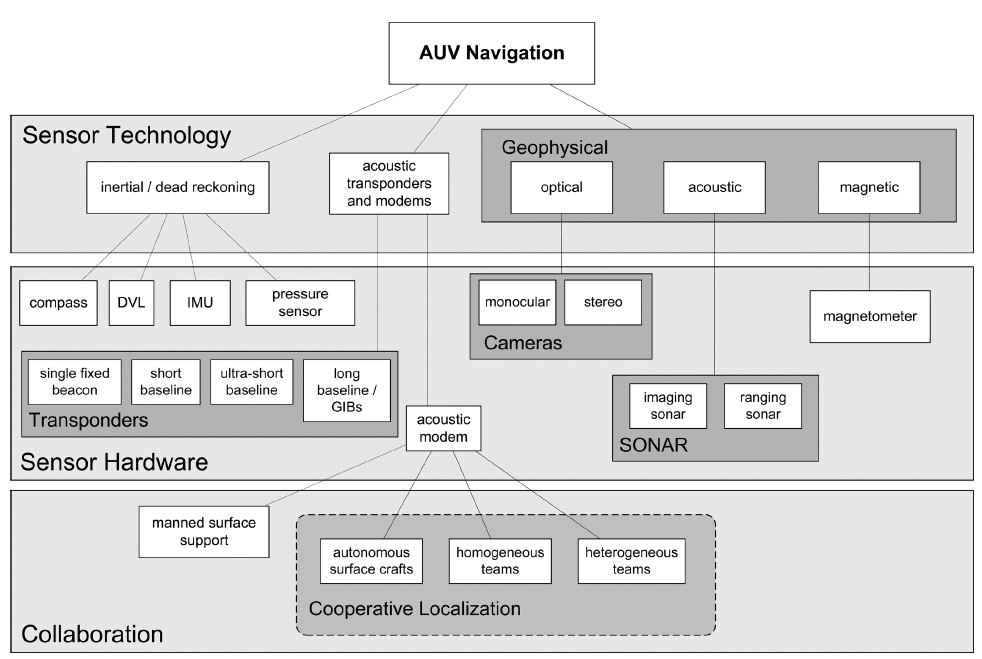

Autonomous Underwater Vehicles (AUV), also known as unmanned underwater vehicle, conducts its survey mission without operator intervention. Their autonomy allows AUVs to be used for missions where a surface vehicle or manned submersible would be at risk, such as mine countermeasure (MCM), under-ice operations or underwater survey missions such as detecting and mapping submerged wrecks, rocks, and obstructions.
When a mission is complete, the AUV will return to a pre-programmed location and the data collected can be downloaded and processed in the same way as data collected by shipboard system. For an AUV to successfully complete a typical survey mission, it must follow a path specified by the operator as closely as possible and arrive at a precise location for collection by a surface vessel. If the final position of the AUV is not accurate, the AUV may be unrecoverable.
If the AUV does not follow the path accurately during the mission, critical features may not be recorded and the position of any features recorded during the mission will be uncertain. Accurate localization and navigation is essential to ensure the accuracy of the gathered data for these applications. A distinction should be made between navigation and localization. Navigational accuracy is the precision with which the AUV guides itself from one point to another. Localization accuracy is the error in how well the AUV localizes itself within a map.
AUV navigation and localization is a challenging problem due primarily to the rapid attenuation of higher frequency signals and the unstructured nature of the undersea environment. Above water, most autonomous systems rely on radio or spread spectrum communications and global positioning. However, underwater such signals propagate only short distances and acoustic based sensors and communications perform better.
Unlike unmanned underwater vehicles (UUVs) which are usually operated remotely by an acoustic modem link, AUVs present a uniquely challenging navigational problem because they operate autonomously in a highly unstructured environment where satellite-based GPS navigation is not directly available.