

A wireless sensor network (WSN) is a wireless network consisting of spatially distributed autonomous devices using sensors to monitor physical or environmental conditions. The self-powered nodes are equipped with sensors of light, sound, heat, pressure, e.t.c, communicating components and data processing that gather information or detect special events and send the data to the base station to be processed.
The emergence of small, low-cost, and low-power sensor technologies like microelectromechanical system (MEMS) sensors, on-board signal processing and wireless communication all integrated on a single chip (system on a chip (SoC)), has stimulated great interests in the utilization of Wireless sensor networks in a wide variety of critical applications.
Wireless Sensor Networks (WSN) are being used in many industrial and civilian application areas including health care, utilities, and remote monitoring. In Smart home concepts they can gather information from environment to provide custom behaviors for a given individual; monitoring temperature, flow level, and pressure parameters in industrial processes like supervisory control and data acquisition; provide real time automatic traffic data collection to assist in alleviating traffic congestion; sensors mounted on heavy duty bridges, within concrete and composite materials and big buildings can enable condition based maintenance of these assets; assist agriculture by providing information regarding soil degradation and water scarcity; supporting mobility while monitoring vital body functions in hospital and home care.
Recently Wilmington police used ShotSpotter technology to pick up the sound of the gunfire and leading them to right block location where they found a car containing the body of a 33-year-old man who was the victim of a homicide. “This narrows the search down quite a bit and directs our officers pretty precisely and accurately as to where to go,” said Wilmington Police Captain Jim Varrone.
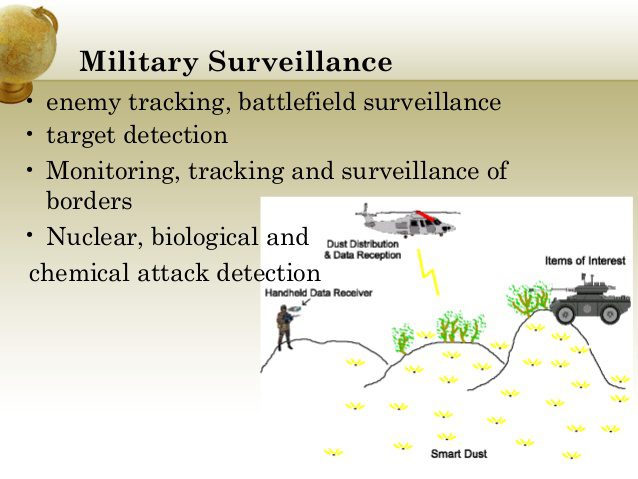
The wireless sensor Networks are also of great practical importance to military in surveillance missions as they allow monitoring of border and other critical areas to provide early warning of hostile events and targets while removing the risk to human personnel. Military applications of Wireless sensor networks include detection, classification, and determining the direction of movement of intruding personnel and vehicles. They are also useful in detection, classification and accurate localization of battlefield acoustic transient events, namely gunshots, RPG, and artillery fires, especially in urban environments. They can also useful for detection of Nuclear, Biological and chemical (NBC) agents.
DARPA had developed “Shooter Localization” technology under its Network Embedded Systems Technology (NEST) program. Ad-hoc wireless network of cheap acoustic sensors were used to accurately locate enemy shooters. Nodes detect shockwave and muzzle blast and send back their data to the base station and Base station then determines shooter location. Fast and accurate enemy shooter localization are key in reducing friendly casualties and neutralizing enemy combatants. The Performance parameters were Average accuracy of 1 meter and Latency of 2 seconds.