
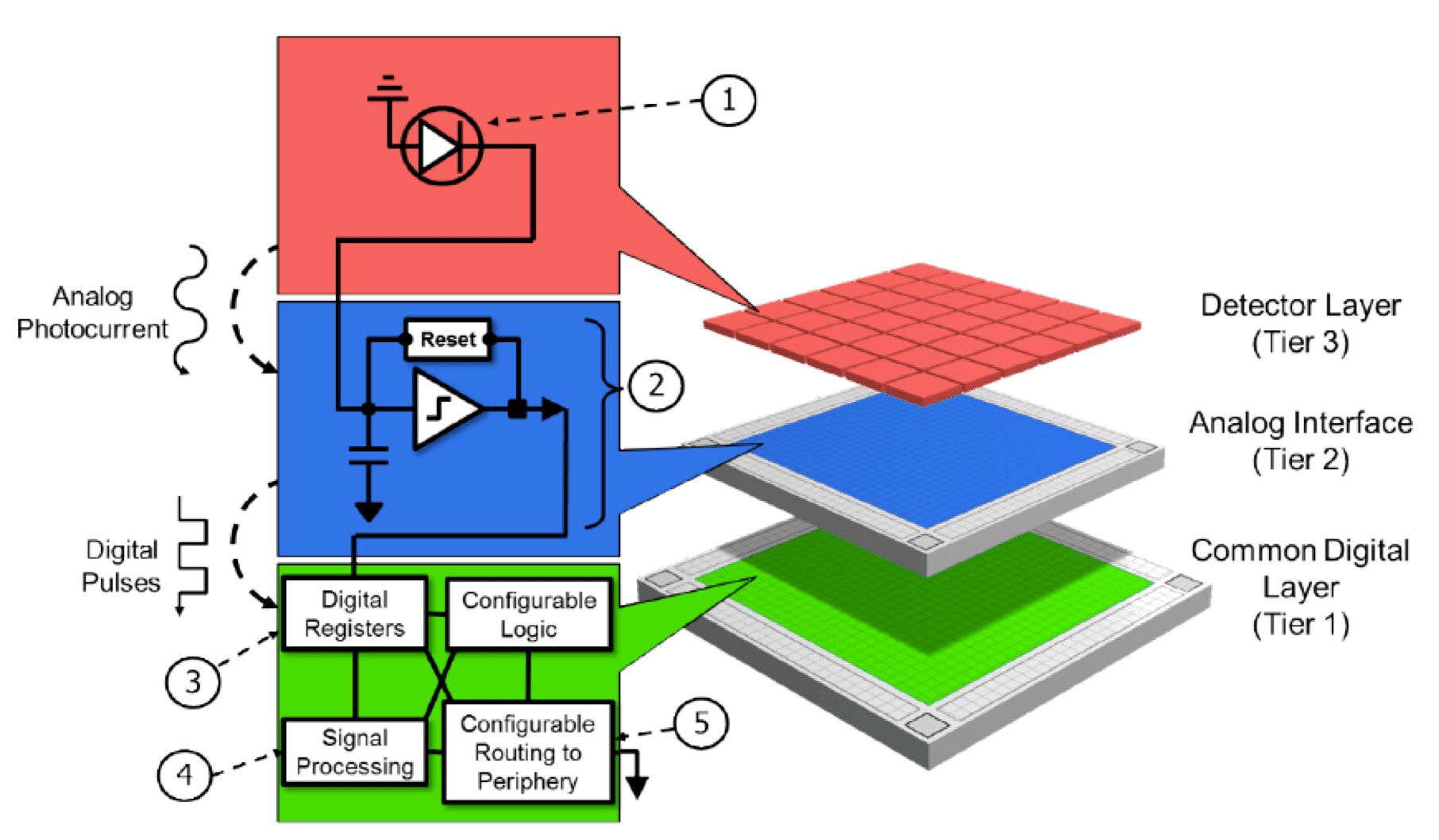

Digital cameras use a focal plane array (FPA) to convert light energy into electrical energy that can be processed and stored. The FPA is a two-dimensional (2-D) array of photodetectors (or pixels) fabricated on an electro-optical material. Modern digital cameras contain FPAs that have pixel counts on the order of megapixels.
Today’s imaging systems primarily perform only a single or limited set of measurements due in part to the underlying readout integrated circuits (ROICs), which sample the signal of interest and transfer these values off of the chip. ROICs are typically designed for a very specific mode of operation, and in essence are application specific integrated circuits (ASICs).
Compared to single-band sensors, the capability to detect scene radiance in both the MWIR and LWIR spectral bands offers important advantages over a wide range of weather conditions, and in the presence of battlefield obscurants, and/or active infrared countermeasures.
Now U.S. military researchers are working with four defense contractors to develop concepts and demonstrate architecture for software-reconfigurable multi-function imaging sensors. The resulting camera technology will incorporate functions that are normally not accessible within a single focal plane array (FPA) by configuring regions-of-interest (ROIs) that operate independently of other regions of the array, and by reconfiguring the measurements being made in the imaging array in response to the scene.
An imaging system that autonomously extracts the most relevant information, using a single sensor, and based only on the context in the scene would revolutionize a wide variety of military and commercial applications.
Reconfigurable capability also could enable users to optimize this imaging sensor for any spectral band, such as ultraviolet (UV) through very long-wave infrared (VLWIR). Separate regions of the focal plane array could run separately at high resolution, or at a high frame rate. In this way, the sensor could perform real-time analysis on much more complex scenes than traditional systems to produce more actionable information to the warfighter than ever has been possible from a single imaging sensor.
Officials of the U.S. Defense Advanced Research Projects Agency (DARPA) in Arlington, Va., have awarded contracts to DRS Network & Imaging Systems LLC in Melbourne, Fla.; Voxtel Inc. in Beaverton, Ore.; The BAE Systems Electronic Systems segment in Merrimack, N.H.; and the Lockheed Martin Corp. Missiles and Fire Control segment in Orlando, Fla., for the Reconfigurable Imaging (ReImagine) program.
This requires the development of a software-configurable array that enables simultaneous and distinct imaging modes in different ROIs. This would provide capabilities that previously required multiple sensors. It also requires algorithms that adapt the sensor configuration in real time based on context, and creates a consistent marketplace for information that seeks to maximize the value of making one measurement relative to the cost of missing others.
The project seeks to develop a software reconfigurable multimodal imaging system whose function is usually not accessible within a focal plane array: the reconfigurable area can operate not only in other areas but also on the reconstructed array of measurements The idea is to develop an imaging focal plane array that can accommodate different conditions and modes of operation, collecting the most valuable information in the scene. Similar to the functions of a field programmable gate array (FPGA) processor, reconfigurable imaging sensors can be defined by using several imaging modes that may be designed after the array is designed.
An imaging system that autonomously extracts the most relevant information with one sensor, and based only on the context in the scene, would revolutionize a wide variety of military and commercial applications, experts say. A software-configurable array that enables simultaneous and distinct imaging modes in different regions of interest might be able to do this.
On May 30, Lockheed Martin received a contract for a potential reconfigurable imaging project worth $ 10.2 million; on June 5, DRS received a $ 10.1 million potential contract; on 1 June, BAE Systems received Potential $ 7.5 million contract; May 30, Voxtel received a potential $ 5.2 million contract. (Ministry of Industry and Information Technology Electronics First Institute Xu Wenqi)